Monday, June 30, 2014

The Unrepentant Speak Good English Movement is Back!

Earlier this year, I published many posts in this blog concerning the shocking errors perpetuated by those who claim to be Singapore's language experts. I had chanced upon two books published by or under the auspices of the Speak Good English Movement and as I said in my blog posts, you can barely read a single page of these books without encountering something unbelievably wrong on grammar, a subject which the books purport to teach their readers.  If you are interested, here is a list of the links to all the posts in this blog that deal with the errors in these two books: CLICK HERE

In the second half of May, I was suddenly seized by a need for a beach holiday and I went away to a nudist resort where I divested myself of not just my clothes but all thoughts of home and spent my days lazing in the sun and acquiring a perfect tan while sipping coconut juice and listening to the incessant waves and squawking of seagulls.  Unbeknownst to me, the Speak Good English Movement had sprung back to life and was making waves of its own in fair Singapore.

I knew nothing about what the Movement was up to until late last night when I saw an online news article dated 28 May. There are two online articles that are of interest to me, both dated 28 May and they are found in:  


EDITOR (14 December 2017): The above links no longer work. Substantial changes have to be made to this article. However, you may find the same press release in the Movement's website at this link.

Both articles tell the same story. Singapore's Speak Good English Movement has embarked on an ambitious programme to make the learning of grammar interesting. Comedian Kumar will star in a series of videos which are designed to teach grammar in an entertaining way.  What truly sent chills down my spine was their plan to publish more grammar notebooks as if the two shamelessly flawed grammar books they currently have to their name aren't bad enough.  I will say more about their two grammar books later.

If you have read my previous blog posts (and if you have not, you can always do so by clicking on the link in the first paragraph above), you will know that I would play a game with their two grammar books. I would turn at random to a page in one of the two books and write a whole blog post on some error I was certain I would find there.  Each time I tried, there was some error so shocking that my friends were outraged that the language experts who wrote the books were not sent to the gallows.  I will deal with the two books later, complete with a photo of them.

Let me go back to the two online news articles and we'll see if perhaps the Movement has got its act together and can now be trusted to at least get its basic language right. Let me pick no less a personage than the Chairman of Singapore's Speak Good English Movement himself.  Naturally, I can only quote from the online article what the Chairman actually said and I will have to assume that the reporting is accurate.  Let me begin with the Straits Times.

This is what the Movement's Chairman said (I'm copying and pasting directly from the online newspaper):


I will confine myself strictly to grammar and I will not comment on the obvious inelegance of that very awkward sentence since the Movement is only interested in grammar and not style.  In that one sentence, however, the Chairman has shown himself to be rather confused over a very fundamental part of basic grammar commonly called "Parts of Speech" which appears at the beginning of every grammar book. It's elementary and nobody who is familiar with the English language can be excused for getting it wrong, far less the Chairman of the Speak Good English Movement.  I need scarcely explain to my readers that the correct sentence should read "...you can check yourself far more easily..."  What we must have is an adverb and not an adjective.  Without a doubt, that sentence the Chairman of the Movement constructed is ungrammatical.  But let's not just stop there.  Let me go further. I want to convince you that you are better off reading my blog (which is free) than paying good money for the Movement's grammar notebooks.

Those of us who love the Bard and have read most of what he's written, as the whole world should, may be tempted to quote from Sonnet 109:

As easy might I from myself depart  
As from my soul, which in thy breast doth lie: 

I have not known of anyone who has the temerity to edit that sonnet to read "As easily might I from myself depart".  Burchfield declares that it is hard to say why Shakespeare's line is "acceptable, even harmonious" while any other departure would be, to quote the OED, "vulgar".  But of course it's not hard to understand why Shakespeare wrote "easy" and not "easily".  The sonnet (as is the case with most of Shakespeare's works) is written in iambic pentameter. "Easily" would destroy the flow and metrical structure completely.  Woe betide anyone who has the nerve to write "I might depart from myself as easy as..." and call on the Bard for his defence.

Let us be clear here. "Easy" is an adjective and, unless you are writing a poem and the metrical structure does not permit you to use the adverb "easily", there is really no excuse for you to ditch the adverb for the adjective. But can "easy" be used only as an adjective?  Are there exceptions?

Yes, there are exceptions where "easy" can assume the role of an adverb but these are found only in some set phrases.  Apart from these set phrases and they are often colloquialisms, "easy" must always be treated as an adjective.  I can think of a few examples of set phrases where "easy" takes on an adverbial nature:

If you are fat, you might want to tell the cook to go easy on the oil.
You might want to tell someone who is visibly agitated to take it easy.
"Easy does it" is what you might say to the movers who are carrying your piano.

I am sure there are other such set phrases but what the Chairman of the Speak Good English Movement said above is not one of them.

[EDIT: 14 December 2017] There is one small point I wish to make here. It's about the laxing of some of these rules in comparatives especially in informal conversations. But even so as recently as 2015, Jeremy Butterfield who is known to be particularly forgiving even in the face of obvious errors has this to say: "But in cases... where easily would have to be used if no comparison were being made, easier is to my mind clearly wrong, or [here, his forgiving nature kicks in], at the very least, inelegant".] 

Now, let's skip to the other online article which is from the Singapore government website. Once again, someone no less important than the Chairman of the Speak Good English Movement himself is quoted directly in this excerpt.

Mr Goh Eck Kheng, Chairman of the Speak Good English Movement says, “We are committed to encouraging Singaporeans to speak Standard English that is used all over the world. Just as we respect the authenticity of other languages, we need to respect grammar rules for the structure it gives to English.”

I was stumped when I first read it. What on earth does the Movement's Chairman mean by "the authenticity of other languages"? Why authenticity?  In linguistics, "authentic language" is simply real language used in real situations as opposed to language designed or contrived for the purpose of teaching grammar and vocabulary.  But it's obvious he's not referring to that.  Every known language has this authenticity in the linguistic sense. It's not something worth mentioning and if it's really the authenticity in languages that he's talking about, he would have said "authenticity in other languages". But even if he had said that, it wouldn't have made sense - what exactly is it that we are respecting? It doesn't at all accord with the overall intent of his speech.

What is more likely is the Chairman was confused over the real meaning of the word "authenticity".  Authenticity does not mean beauty or expressiveness or clarity. Or did the Chairman mean "authority" which although shares the first four letters with "authenticity" does not have any connection with it in meaning? The English language has a vocabulary wide enough to accommodate all these different meanings and nuances. Authenticity, in non-technical usage, can only have two meanings:

1.  Something is authentic if it is real or genuine and of undisputed origin. If you question the authenticity of a manuscript that is purported to have been written by Shakespeare, you are saying that the manuscript is not genuine and it wasn't written by Shakespeare.

2.  "Authentic" can also mean reliable or trustworthy e.g. "He gave an authentic account of the road accident".  Hence, there is authenticity in his testimony.

I have no doubt that the Speak Good English Movement consists of highly honourable people with the best of intentions. They have put in hours of hard work to help the people of Singapore speak and write better English. But I'm an honest man and I will speak plainly. I have in more than 20 blog posts shown quite conclusively that they are not really equipped or qualified to take on such an onerous task. They are clueless about correct grammar and they do not have an understanding of the meanings of words. We can't have a situation of the blind leading the blind. People in Singapore generally have an excellent command of the English language. Most of us are far more knowledgeable in grammar and usage than those in the Speak Good English Movement and if the Movement's two grammar books are anything to go by, we certainly will fare far better without the erroneous grammar tips and flawed language guidelines that they have so far come up with.

Let me now say a few words about the two disgraceful books that I have referred to repeatedly in this post.


English As It Is Broken and English As It Is Broken 2 are books written, supported or promoted by the Speak Good English Movement, the Ministry of Education, the National Library Board and the Straits Times. From what I can see, these two books are looked upon as the crowning glory of the Movement's achievements.  However, as I have shown in my previous blog posts, the English language "experts" who wrote these two books are so ignorant of basic English grammar that almost every page is riddled with shocking errors on grammar.  In some instances, students who wrote in to ask the panel of "experts" a point of grammar are taught to write ungrammatical sentences and what is really appalling to me is the fact that these students would have been better off not seeking their advice in the first place.  I've given a few examples in my earlier blog posts where students started out perfectly correct grammatically but the experts tell them they are wrong and give them rules of their own making which flout official grammar rules accepted by all grammarians. For the convenience of my readers I have listed in a single page all the links to my posts that deal with the grammatical blunders in these two books. Please click here.

It was not without some disquiet when I read last night that the Speak Good English Movement would be publishing "grammar notebooks".  Are they enlisting the help of the same "experts" who wrote their two erroneous books? Shouldn't the Ministry of Education look into this?


EDITOR (14 December 2017): If you think these two books on grammar were published a long time ago and the Speak Good English Movement has now changed for the better, nothing could be further from the truth. In early 2017, the Movement published a new book called 'Grammar Rules' in which they displayed the same total ignorance of grammar. Because the book contains so many errors, I wanted to split up my criticism of it into at least 5 separate blog posts in order to cover them all but after having written 2 blog posts on their shocking errors, I became lazy but hey, I've got my own life and correcting the errors of the Speak Good English Movement requires full-time dedication. They can't seem to get their grammar right and so everything they publish needs correction. You may read my two blog posts on their new 'Grammar Rules' here:
The Speak Good English Movement's new grammar book and
The Speak Good English Movement's new grammar book - Part 2 

Friday, June 27, 2014

On Gambling and Gays


I attended a talk yesterday on “Gambling Addiction” organised by the NUS Alumni. The speaker, Mr Liew Heng San, has impressive credentials. He was in CPF and some other government portfolio but it was his religious affiliations that brought in the crowd. I saw countless people from my church and other churches. I met a friend of mine who is a clergyman and although he’s not an NUS alumnus, he received an email through the church network. Another church friend I met at the talk told me that the speaker spoke at a recent church camp and he was a dynamic speaker.

The speaker was very engaging and his audience which filled the hall in the Alumni building all listened attentively. He covered the destructiveness of gambling addiction and he talked about the social costs and what he considered the insufficient safeguards for citizens. Then came the punchline which was what I always look out for in a talk.

The speaker is of the view that the Singapore government is not doing enough to stop the citizens from going to the casino. The speaker has the most negative view of the casino. He says the casino is essentially a “temple” where time ceases to exist. That’s why there are no windows in a casino so you can’t tell day from night and time stands still and you gamble without ceasing. He also says the slot machines in a casino have subtle messages such as “May my luck be upon you”. He claims that they are using liturgy to indoctrinate the gambler. Although he is addressing the NUS Alumni which is not a religious group, it is not difficult to see that the talk was very much infused with the speaker's religious values and standard.

The speaker claims that the authorities are, in their protection of citizens from the evils of the casino,:

1.   Incompetent. Singapore adopts an opt-out system for those who want to be excluded from the casino. He is of the view that what the government should have done was to have an opt-in system, i.e. everyone is excluded from the casino unless he opts himself in. He shows statistics why an opt out system is not effective.

2.   Lacking in integrity.

3.   Lacking in benevolence.

For both the last two points, the speaker says that the government has a special form that allows foreigners to have themselves excluded from the casino. Singaporeans and permanent residents, he says, are not given the opportunity of excluding themselves from the casino unless they do so online through their SingPass and children and many old people do not have a Singpass account.

The speaker distributed this form to everyone in his audience.


It’s the National Council on Problem Gambling’s form for the Application for Self-Exclusion for Foreigners. He suggests that we should all fill in the form and take it to our MPs to insist that we register ourselves to be excluded from the casino. This will signal to the authorities that they should have a similar form for citizens and permanent residents.

I found the whole talk unnecessary and even laughable. Before I continue, I should make it clear that I’m not on the side of casinos or gambling. I have no vested interest in the casino. I have never gambled in my entire life. I have not even laid a bet for 5 cents in my whole life. I have been to Las Vegas but only to go on rides and watch the many exciting shows there. I was "beheaded" in a magic show in MGM Grand and it was fun and the show was free! I have never placed a single coin in any of the slot machines or laid a bet in any of the poker games or card games or roulette nor do I know how to play these games. When I watch a movie and there is s a card game and the cards are slowly revealed to the viewers, I can’t tell if it’s a winning hand because I really don’t know what hand wins in a card game. I have never laid a single bet in 4D or Toto or a football pool or anything that can however remotely be considered gambling. I’m really an absolute non-gambler and nobody can claim to be less a gambler than I.

But I don’t see the casino as evil and I don’t think the authorities have been slipshod in protecting the citizens from problem gambling. I believe it’s for the individual to decide whether he should or should not go to a casino. Casinos do not force you to go to them. I’ve not been to one and I have not received any death threat for not having patronised the casino. And not everyone who goes to the casino ruins himself. I’m sure the majority of gamblers only gamble a few dollars away each time. That’s no different from going shopping. Those who kill themselves and the speaker gave a few examples of people who commit suicide because of gambling debts are very few statistically. These people probably would have incurred other debts even if they had not gone to the casino. I really don’t see the casino as such a strong force for evil. And I really don't see why the government should exclude everyone from the casino. Isn't the government always criticised for being too interfering and don't Singapore's detractors label Singapore a nanny State? The government might as well legislate to make it an offence for citizens to eat too much fatty food. What's so inherently bad about the casino anyway? Why then was the speaker so dead opposed to the casino?

One common thread that runs through all the fierce opposition against anything, be it gambling, abortion or homosexuality, is religion. Many of us are blind to the fact that deep down, we religious people want very badly for the whole world to conform to our religious values. Even if we are not blind to this fact, we are usually not willing to admit it openly.

But Singapore is a secular state and it’s very wrong of us to try to make it comply with our religious requirements. I read in the newspaper how a religious leader in a church has decided to join forces with a Muslim group in opposing the Pink Dot celebration tomorrow. He claims that he wants to affirm the importance of the family with the Muslim group. But that is of course nonsense. The Christian idea of a marriage is very different from the Muslim model. In Christianity, a marriage must be monogamous and there is no compromise here. Islamic tradition allows for polygamy.

That is one good reason why Singapore adopts secularism at the national level. Religions are all cultural and our cultures differ wildly and that’s not surprising since each culture is very much dependent on its past and the environment which shaped it in the first place. No group should force its own values down the throats of other people. What a government minister said recently is absolutely correct. When it comes to religion and personal preferences, you really should keep it to yourself and be sensitive and accept that others have the right to differ.

I was brought up in a no-gambling culture and to this day I have never gambled and don’t know how to and I probably won’t ever gamble for as long as I live. But my wife grew up in a different culture and my mother-in-law does gamble. Although my wife converted to my religion when she was still in school and she does not gamble, she has a much more tolerant view of gambling than I used to have when I was younger and more headstrong.

I hope the gay and lesbian community will have a lovely day tomorrow as they celebrate the Pink Dot day. It would be churlish if we who are heterosexual begrudge our gay friends the right to love and express their love openly. It’s my prayer that the love that dared not speak its name in the 19th century will shout it out from the mountaintops tomorrow at the Pink Dot celebration.

Saturday, June 14, 2014

WHEN BLASPHEMY IS SOMETIMES DESIRABLE


A superstitious Indonesian domestic maid once worked for me and my family. She said that her village was entirely Muslim and her first experience being in the company of non-Muslims was when she came to work for us. You would have thought that she would have been a Muslim extremist but she was not at all. Although she was schooled in a madrasah, she had a very tolerant view of religion and she held the view that Muslim suicide bombers would all be sent to hell. But in her village, she had recently witnessed the burning of a witch. I asked her if the witch was an old woman who lived by herself, a widow perhaps? She was surprised and asked how I knew. I told her our human history had seen many old widows being burnt to death for alleged witchcraft and it was nothing new. But she insisted the old woman was a witch and she claimed she had magical powers. She said if they hadn't burnt her, Allah himself would have done so and probably burnt half the village as well.

One day I was driving the car with her on an errand when the sky turned black and flashes of lightning could be seen accompanied by loud peals of thunder. She was cowering in the corner in fear. I asked her if God had the power to strike us with a lightning bolt. She tried to hush me but I went on talking.  From asking questions about God's power, I went on to questioning if God had the courage to strike us and what if I threatened him with physical violence? And then I crossed the line into outright blasphemy.  She told me that was the end. There was no way we would reach our destination safely. God simply would not allow us to escape with impunity after what I had just said. But of course we reached our destination without any incident.

On the return journey, she told me that this was the first time she had seen anyone who had so much courage to challenge God. She claimed that nobody in Indonesia would dare to do that. I asked her where she thought God was. She replied that God was at that point in time driving a car and talking to her. And she burst into laughter. I asked her if she wasn't afraid that God might strike her down with lightning. She replied laughingly that if God had no ability to do it during a thunderstorm when there were lightning flashes everywhere, he couldn't possibly have the power to do it when the rain had stopped and the sun was shining.

That was the moment for me to seize my opportunity. I told her it was all right to believe in God and in religion but the moment someone was going to be killed, that was the time to put the foot down. I told her there were no witches and witchcraft was all fictitious but even if there were witches, she should leave it to God himself to punish them. If he doesn't do anything, his followers should not do his dirty job for him. Leave it to God. It didn't matter if someone blasphemed God or if he were an apostate or witch or whatever he might be accused of being. If God did nothing, his followers must not attempt to play God themselves.

I'm just hoping that my blasphemy will save the next old woman from being burnt to death in her village. If I succeed in saving just one old woman from such a horrid death, I'm sure even God himself would be delighted that I could blaspheme better than any cranky old foul-mouthed sailor.

Saturday, May 17, 2014

WHY NUDITY IS NATURAL AND SHAME IS WARPED

Do you tell a child that there are parts of his or her body which are indecent, obscene and unacceptable and he or she must learn to feel shame with regard to them?  Chances are you do although you might not do so in so many words. Throughout our lives, we enforce the belief that there are parts of our bodies which are so obscene and indecent that they cannot be exposed and seen by others.

It is this societal reinforcement since early childhood that there are parts of our bodies which we should be ashamed of that has led to a great deal of needless anxiety and fear and this has been seized by criminals to trap and blackmail adolescents that we see on the news recently. See this BBC report.

But why do we come up with this ridiculous notion that there are parts of our bodies which are obscene in the first place. There can be only one reason - our obsession with sex. People who are dead opposed to any form of nudity are usually sex-crazed and they associate the human body with sex. They probably accept a worldview that looks upon sex generally as wrong and embarrassing.

Religions such as mine have very strong words against any form of sexual conduct that does not conform to its strict rules of permitted sexuality - sex within a monogamous marriage. But this is important - Christianity has absolutely no prohibition on nudity and while St Paul may rail against sexual misconduct, the church in his day conducted Holy Baptism in the nude. I will talk more about this later. The fact is St Paul and the early Christians did not equate nudity with sex. In other words, although St Paul had a lot to say about sex, he was not one with a singular obsession with sex and he was quite unlike many we see in the church today.

For a long time, humankind had no problem with nudity. In ancient Greece and Rome, nudity was not considered such a huge embarrassment. Greek gods are represented in their naked glory and athletes who competed at the foot of Mount Olympus (the origin of our Olympics) were all without exception stark naked. The early church did not view nudity as inappropriate. The early church fathers tell us that the Sacrament of Holy Baptism was conducted entirely in the nude. It was only after a Christian had been baptised that he or she was clothed in new clothes to symbolise a new life in Christ. Today, it’s unthinkable to have anyone naked at baptism. It would most certainly be looked upon as sacrilegious.

Below are pieces of early Christian art depicting nudity during the Sacrament of Holy Baptism.


What caused this change?

The monastic tradition made us look upon the naked body as sinful and evil and ought to be subjugated. In the early church, there were heretics who held precisely that belief. They claimed that Jesus was totally spiritual and divine and only appeared to be in the flesh. They denied the Incarnation of Christ.  They held the view that the human flesh was sinful and evil and Jesus could not have taken on bodily flesh since he was perfect. These heretics, also called Docetists, were condemned by the New Testament writers. St John’s Gospel which clearly spelt out that Christ came in the flesh was meant to put down this belief of Docetism. Docetists looked upon the human body as not just corruptible but totally corrupt and should be repressed and covered and to expose the naked body was to encourage people to commit sinful debauchery.

The monastic tradition of the church somehow harked back to this Docetist view of the body but without altering the Christology. As long as the doctrine of the nature and person of Jesus Christ was not affected, the Church was happy to accept any view that puritanically relegated the human body to the depths of depravity while at all times preserving the doctrine of Christ’s humanity and Incarnation and St John’s teaching that Christ came in the flesh remained intact. So the human flesh was thought of as evil and the naked body as filthy and unacceptable. Monks would carry out the practice of self-flagellation as a means of subjugating the sinful body and there are accounts of monks who whipped themselves to death.

The Dark Ages are over and we no longer whip ourselves but we continue to carry the shame and guilt that we attach to our bodies as evil and sinful. That explains the shame that we feel and there are many of us who would rather give an arm and a leg than have our nude photos posted online by a blackmailer. How warped we are that we view a perfectly fine organ of the body that is necessary for the propagation and continuation of the human species with so much shame, guilt and distaste.

As I have shown, religion does not criminalise nudity. It's our perverted and warped thinking which is motivated and charged purely by our unhealthy obsession with sex that makes us view nudity with so much shame and loathing.  The more negatively you react against nudity, the greater your obsession is with sex.

Thursday, May 15, 2014

Oh God!

Our perception of God is sure to have undergone some transformation since the time we were toddlers. A toddler's understanding of God cannot be the same as that of an adult. But on a broader plane, humanity's perception of God also differs from culture to culture and from time to time even within the same religious culture. As always, I will only zoom in on my own religion which I'm familiar with.

Almighty God, in the Christian sense, has not meant the same thing throughout the ages. He started out as a more physical or carnal version of the divine. He made many physical appearances . He was weaker and less knowledgeable. He had a face that could be seen but nobody dared to view his face and they were content to look only at his back. He didn't know why Adam and Eve hid themselves away and had to ask them. Of course apologists scramble to explain that He knew all along but just asked anyway, possibly to get them to confess. He also wrestled with Jacob all night.  A subsequent generation re-wrote the passage and referred to God in this wrestling match as "the angel of the Lord". But as always, when scribes re-write the Bible, they are averse to changing everything probably out of reverence for the text they consider sacred and so the passage looks odd with the angel of the Lord also being referred to as God himself. Elsewhere, we read of the angel of the Lord receiving worship, which in the Judeo-Christian tradition is reserved purely for God.  The Church tries to explain away this anomaly by postulating that the angel of the Lord is the pre-incarnate Christ.

That leads to a problem more thorny than the original one that we have. We are precisely a month away from Trinity Sunday (which falls on 15 June this year), a day that meant a lot to me many years ago when I was an altar boy. Trinity Sunday is an important day in church. It's one of the Principal Feasts and I liked the day mainly because we would recite the Athanasian Creed which I found quite hilarious. That's a creed which we don't always say because it's so long and convoluted and if anyone is going to trip over his creed, it's got to be this creed. I thought of it as an amusing creed and the name ascribed to it in our prayer book, "Quicunque vult" made it, at least to me, the clown of all creeds.  But the creed underlines the basis of our faith, or so my vicar (who subsequently became an Archdeacon) told me. It separates the world into believers who say the creed and heretics who don't.  The Creed and Trinity Sunday were devised to dispel the Arian Heresy.

Briefly, all Christians, whether they are Roman Catholics, Protestants or Orthodox, believe in God as the Holy Trinity. The Arian Heresy is the heresy that declares God the Father to be above the other two, namely, Jesus and the Holy Spirit. But the dispute only came about in the 4th century. There were notable scholars and theologians in the 3rd century who had a belief that although predates the Arian belief is similar to it but I'll talk about them later.

Every Christian is taught from the cradle that there is one God, one Lord but three Persons.

In the Athanasian Creed, we say that the Father is God, the Son is God and the Holy Spirit is God and yet there are not three Gods but one God. Why is that so? That's because the unity of God is central to the Old Testament and the whole of the Old Testament also forms a part of the Holy Bible which we Christians revere as the Word of God.

In the Athanasian Creed, we recite that the Father is Lord, the Son is Lord and the Holy Spirit is Lord and yet there are not three Lords but one Lord. Now, why do we say that? Again, because in the Old Testament, God commands the people to recite the shema twice a day: "Hear O Israel! The Lord thy God is one Lord".  So we can't have three Lords but only one Lord.

Any Jew today will tell you that to call Jesus Lord and the Father Lord and the Holy Spirit Lord would be to contravene the clear wording of the shema. What the Church has done is to play around with words. We insist that all three are Lord but there is only one Lord and yet the three are distinct.

What the Church does is to introduce a new term into the idea of God.  And that term is "Person". As the Creed provides, there are three Persons in the Holy Trinity. We don't say three Gods because that would fly against the very pillar of monotheism which Christianity claims to be and we don't say three Lords because that would contravene the precise wording of the shema. But we say three Persons because the word "Person" is a new introduction into the religion.

But just think about it for a moment. How would the writers of the Old Testament prevent our Christian introduction of the Holy Trinity into the concept of God? What they have devised is as clear as it can be. "Hear O Israel! The Lord thy God is one Lord". How were they to know that we would introduce "Person" into the Godhead? Even if they had said "The Lord thy God is one Lord and one Person", I assure you the Church would have said the Father is a Person, Jesus is a Person and the Holy Spirit is a Person and yet there are not three Persons but one Person. And then we will introduce another term, perhaps "Entity" and say God is in three Entities. It's one God, one Lord, one Person but three Entities. That's how creative the Church is.

Origen


This has not always been so for the Christian Church. In the third century, the great Christian scholar and theologian, Origen, who was a prolific writer of theological books declared that Jesus was the firstborn of all creation, ie Jesus was the first creation of God. But he didn't get into trouble because the Church had not yet come up with its clear teaching of the Holy Trinity. In other words, the properties and nature of God had not yet been fully determined by the Church. Besides, he was merely repeating the words of St Paul which appear in our Holy Bible that Jesus is "the firstborn of all creation". Of course at that time, the Church had not reinterpreted that verse to declare that the firstborn of all creation is not a creation. This may sound strange to non-Christians who are not used to the concept of reinterpretation by the Church. Whenever we encounter a problem verse in the Bible that doesn't square with the doctrines the church has come up with, what the church does is to reinterpret the verse to mean something the language itself does not mean. We do the same thing with verses that are obviously wrong. Eg when Jesus declared in at least five different places in the Holy Gospels that he would return to earth in the lifetime of his first apostles and obviously he didn't, the church decides that Jesus didn't mean that when he said that.

So, no Christian will have a problem with saying that although Jesus, according to the Holy Bible, is proclaimed to be the firstborn of all creation, he was never a part of creation. We follow the reinterpretation of the church and to hell with the clear wording of the Bible.

But how was poor Origen to know that in less than a hundred years after his death, the Church would redefine the properties of God so that Jesus became co-eternal with the Father? All Origen's books were declared anathema by the church and poor Origen became a heretic posthumously. What a rotten thing to do to a person who cut off his own genitals just so that he didn't sin against God with his lust. Again, this is what Jesus says in the St Matthew that if your hand causes you to sin, cut it off and throw it into the fire. Poor Origen made the horrible mistake of following the Bible too closely.

In St John's Gospel, Jesus says, "If you loved me, you would be glad that I am going to the Father, for the Father is greater than I". Arian heretics have all depended on this verse to justify their belief that Jesus is not equal to the Father. But if you don't go along with the Church's redefinition of God, you're a heretic, never mind the biblical verses you can call upon to justify your stand.

So the way I see it as we progress towards the holy Principal Feast of Trinity Sunday, God has undergone various redefinitions over the centuries. He started out as the God of a nomadic tribe and he was more earthy and physical; he appeared in person and although nobody dared to look at his face, they all saw his back. So God had a back like any creature that can be gazed upon. He even wrestled with Jacob for the whole duration of the night. Of course Christian theologians have given a thousand different meanings to that episode and have romanticised it and infused the wrestling God with the Person of the Pre-incarnate Christ but that's a later reinterpretation. As the Israelites settled down, God took on a more spiritual nature and became less earthy but at the same time, he became more powerful and omniscient. And his unity or one-ness is emphasised. God is One. Jesus started out as someone subject to God. But by the time the Gospel of St John was written (that's the last of the canonical Gospel to be written), Jesus had assumed divine stature but God the Father was still greater than he (John 14:28). By the late 4th century and certainly by the First Council of Constantinople, the co-equality of Jesus with the Father became indisputable and if you don't say "Credo" to that, you're a heretic and all your books anathematised.

What do I see for the future of God in this age of easy access to information and beyond this age? Will God further evolve into anything else? God has transformed from being physical to spiritual. Will God undergo a further transformation so that he becomes metaphorical? I see that as a very likely possibility but the church moves slowly and woe betide anyone who goes ahead of the church. He'll be branded a heretic.

BALI - THE ISLAND OF THE GODS PART 3

I was once eating lunch alone in a warong in Ubud listening to the soothing strains of the gamelan quartet and thinking to myself how tender the bibik in my mouth was when the gamelan players took a break from their instruments and one of them asked the rest if they were going to "the ceremony" the next day. It immediately caught my attention because I had made no plans for the following day and any Balinese ceremony should be interesting to me. I smiled at them and showed some interest in the conversation. One of them asked me if I understood Bahasa Indonesia. That was the opportunity I was waiting for and I told them I was fluent in the language. I then casually asked them what "ceremony" there'd be the next day. A cremation ceremony, one of them told me. Telling a tourist in Bali that there's a cremation ceremony is like telling gold diggers during the Gold Rush that you'd found gold up the river. There's sure to be a scramble for it. I asked where it would be held and what time. The information I got was not as precise as I would have liked. I was only given the name of the village. But what's the address? I won't miss it, they assured me, if I went to the village. But what time is the ceremony? Just go in the morning, I was told, which wasn't much of a help.

The next morning, I got a cab to take me to the village. I asked the cab driver if he knew about the cremation. He didn't. He dropped me off at the village and I walked round looking for a house that stood out from the rest.  I was getting a little worried if I was in the right place. After all, I had only heard of the cremation from the gamelan players and they weren't very precise with the details. Perhaps they were mistaken.

But I walked down a few roads looking at the rows of houses and trying hard to pick up something that might indicate that it was a house of mourning.

I didn't have to go very far before I saw this - the golden calf - and I knew I just had to stick around.

I could identify the house which had a flurry of activity. There were very loud and garish decorations in the house which were filled with people walking in and out. I looked around me and I spotted an elderly Caucasian couple. They were Americans and the husband was a Christian missionary in Bali and they had lived in Bali for three of four years. They had come to witness the cremation. I asked them if they would like to accompany me into the house just to get to know the family. I felt it wasn't right to just gatecrash a funeral. Surely the least we should do was to convey our condolences to the family? The elderly woman said they didn't speak a word of Indonesian and they would just stand around and wait. So I proceeded into the house.

I spoke to somebody who looked like he was directly related to the deceased and I asked him in Bahasa Indonesia if I could convey my condolences to the family. He took me into the house and I was introduced to the wife of the deceased and the rest of the family. What puzzled me was everyone was in good spirits and there was no mourning at all. They were all smiling and joking. I was told that the deceased died many months ago and they had kept the body for this cremation day. A funeral was a happy occasion, they told me.

It's not easy for me to go to a house of mourning because I can't remain mournful for long. But a Balinese funeral is not in any way mournful. Soon, I was joking along with the family. They told me that the procession was about to start. They would be taking the body to the cremation ground. Everyone was leaving the house carrying food offerings for the dead.  I asked the family if it was all right for me to take photographs. They told me I was more than welcome to take as many photos as I wanted. That was the green light I was waiting for. I couldn't just take photos of a funeral without the express permission of the deceased's family.

I left the house together with everyone else. The American couple were nowhere to be seen. Perhaps they felt uneasy and had gone off. That meant I was the only outsider in the entire village. But I felt quite at home with the people. And I really put my camera to work.


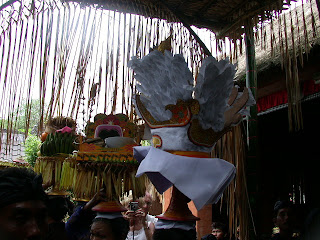
This decorative structure forms a part of the funeral procession.


There are lot of people at the funeral and they all seemed to have their own roles to play.


A priest blessing some of the attending ladies.


The house of the deceased's family.


There are dozens of ladies carrying on their heads food offerings for the dead


The person who is dressed in this horrid looking mask and attire is the grown-up son of the deceased. He is walking on stilts. It's probably a part of the funeral ritual.


More food offerings


The coffin is being moved from the house to the hearse.


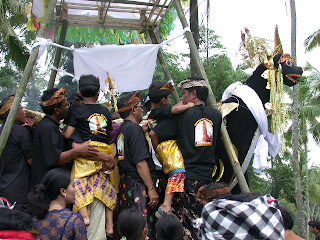
Another son of the deceased dresses up as this monster, probably some character in a story from the Ramayana.


The village musicians.


This is the unsheathed machete I was talking about in my earlier posts. It's the sort of photograph I fancy National Geographic might take an interest in.


The funeral procession.


We arrive at the cremation ground.


The village gossips, I mean, minstrels.


The musicians make themselves comfortable on the grass


The deceased receiving a final blessing from the priest


The grandchildren are taken to see their grandpa for one last time. Interestingly, nobody sheds a tear, not even the children. We have a lot to learn from them. For many of us who claim we believe in life after death, we certainly don't behave that way at funerals.


Village musicians and singers taking a rest


The funeral pyre is lit


The body is still on top of the golden calf


The body has collapsed to the lower level - under the calf.


The skull takes a very long time to burn


The 4th and final part of this series will be written when I'm next in Bali, the Island of the Gods.

Tuesday, May 13, 2014

BALI - THE ISLAND OF THE GODS PART 2

WARNING: IF YOU ARE DISTURBED BY IMAGES OF DEAD BODIES AND CORPSES, PLEASE LEAVE THIS POST NOW.


There is a village in Bali called Trunyan which according to the Lonely Planet guide many years ago is inhabited by a tribe of original Balinese people called the Bali Aga. These people are known to be generally hostile to foreigners and strangers and unlike the traditional Balinese who cremate the bodies of their dead, the Bali Aga do not. You probably think that if they don't cremate the dead, they must of course bury their dearly departed. No, they don't do that. They just leave the corpses to rot.

I drove my rented four-wheel drive through rough terrain until I came to the part of the road where a small off-beaten path departed from the main road and seemed to go over the cliff to the lake below.


I looked carefully and I saw that the path went down a steep incline and I wasn't sure I dared to drive my car down such a slope. There were no barriers on the side of the sandy path and a mere slip to one side would spell disaster. But the lure of the village of Trunyan was too great and I emboldened myself and took the plunge, literally.

It wasn't so bad as I had expected. The path was very long but soon I was down on level ground. The road from which I had come was way up in the distance above me and I was now on the bank of Lake Batur.

The imposing volcano Gunung Batur stands over the lake.

The only way to get to the island of Trunyan is by boat.


Approaching the village of Trunyan.


There were groups of villagers staring at me as I entered the village. I was careful not to take their photos because at that time, they were still not familiar with the sight of tourists and I was the only outsider there. The boatman was a little nervous and he kept telling me not to take photos of the people. But I had to at least take some photos.


Below are pics of the village temple. Not the spruced up tourist-friendly temple but one that services the village well.

The boatman said his prayers in front of this altar before ushering me to his boat for it was time for us to go to Kuburan, again, accessible only by boat.

Kuburan is the burial ground for the dead. No, there is no burial. It's more like a dumping ground, for want of a better term.  Upon arrival at the bank of Kuburan, the visitor is greeted by a row of skulls.


All the dead bodies are placed on the ground and covered with 9 different kinds of flowers to take away the smell of the rotting flesh. All I could smell on Kuburan was the strong fragrance of flowers. But the smell was not that of any flower I'm familiar with. I think it's an odd mixture of the smell of rotting flesh and flowers but it's not so bad as to put off a visitor. You wouldn't know there were dead bodies around you just by the smell.

Around each body, a small "tent" of bamboo sticks is erected.


Here's a close up of one of the tents. You can see the body within and a hand that seems to have come out in between the bamboo poles.


Before leaving Kuburan, I felt I had to take a final shot as a personal souvenir. I checked with the boatman who didn't think it was disrespectful so I proceeded with this pose.


I had thought of squeezing two different funeral styles that I have witnessed in Bali into one page but I can see that this post is already extremely long. I will break it up so this 3-part series on Bali will become a 4-part series. In Part 3, I will post a story about a totally different funeral ritual that I attended in Bali. Part 4 will be a story which I will post when I am in Bali which will be not long from now. I promise you Part 4 will be something quite different from what the average tourist has experienced.  Yes, very different indeed. In fact, it may be so outrageously unconventional that I might be compelled to password-protect Part 4 or segments of it.