Showing posts with label The World. Show all posts

Friday, February 10, 2017

Liberal Loonies Linguistically Trumped.


I've been told that it's very hard to find a single educated person in the US and you can walk the entire length and breadth of this massive country for months without encountering a single literate person but I'm sure that's a cruel exaggeration. But it is a fact that whenever a person exposes his lack of education on an internet platform, he is more likely to be American. Years ago, on an Internet forum, a few Americans made fun of me because I spelt 'spelt' that way. They were insistent that 'spelled' was the only correct spelling for the past and past participle of the verb and anything else was an error.

Thursday, May 15, 2014

BALI - THE ISLAND OF THE GODS PART 3

I was once eating lunch alone in a warong in Ubud listening to the soothing strains of the gamelan quartet and thinking to myself how tender the bibik in my mouth was when the gamelan players took a break from their instruments and one of them asked the rest if they were going to "the ceremony" the next day. It immediately caught my attention because I had made no plans for the following day and any Balinese ceremony should be interesting to me. I smiled at them and showed some interest in the conversation. One of them asked me if I understood Bahasa Indonesia. That was the opportunity I was waiting for and I told them I was fluent in the language. I then casually asked them what "ceremony" there'd be the next day. A cremation ceremony, one of them told me. Telling a tourist in Bali that there's a cremation ceremony is like telling gold diggers during the Gold Rush that you'd found gold up the river. There's sure to be a scramble for it. I asked where it would be held and what time. The information I got was not as precise as I would have liked. I was only given the name of the village. But what's the address? I won't miss it, they assured me, if I went to the village. But what time is the ceremony? Just go in the morning, I was told, which wasn't much of a help.

The next morning, I got a cab to take me to the village. I asked the cab driver if he knew about the cremation. He didn't. He dropped me off at the village and I walked round looking for a house that stood out from the rest.  I was getting a little worried if I was in the right place. After all, I had only heard of the cremation from the gamelan players and they weren't very precise with the details. Perhaps they were mistaken.

But I walked down a few roads looking at the rows of houses and trying hard to pick up something that might indicate that it was a house of mourning.

I didn't have to go very far before I saw this - the golden calf - and I knew I just had to stick around.

I could identify the house which had a flurry of activity. There were very loud and garish decorations in the house which were filled with people walking in and out. I looked around me and I spotted an elderly Caucasian couple. They were Americans and the husband was a Christian missionary in Bali and they had lived in Bali for three of four years. They had come to witness the cremation. I asked them if they would like to accompany me into the house just to get to know the family. I felt it wasn't right to just gatecrash a funeral. Surely the least we should do was to convey our condolences to the family? The elderly woman said they didn't speak a word of Indonesian and they would just stand around and wait. So I proceeded into the house.

I spoke to somebody who looked like he was directly related to the deceased and I asked him in Bahasa Indonesia if I could convey my condolences to the family. He took me into the house and I was introduced to the wife of the deceased and the rest of the family. What puzzled me was everyone was in good spirits and there was no mourning at all. They were all smiling and joking. I was told that the deceased died many months ago and they had kept the body for this cremation day. A funeral was a happy occasion, they told me.

It's not easy for me to go to a house of mourning because I can't remain mournful for long. But a Balinese funeral is not in any way mournful. Soon, I was joking along with the family. They told me that the procession was about to start. They would be taking the body to the cremation ground. Everyone was leaving the house carrying food offerings for the dead.  I asked the family if it was all right for me to take photographs. They told me I was more than welcome to take as many photos as I wanted. That was the green light I was waiting for. I couldn't just take photos of a funeral without the express permission of the deceased's family.

I left the house together with everyone else. The American couple were nowhere to be seen. Perhaps they felt uneasy and had gone off. That meant I was the only outsider in the entire village. But I felt quite at home with the people. And I really put my camera to work.


This decorative structure forms a part of the funeral procession.


There are lot of people at the funeral and they all seemed to have their own roles to play.


A priest blessing some of the attending ladies.


The house of the deceased's family.


There are dozens of ladies carrying on their heads food offerings for the dead


The person who is dressed in this horrid looking mask and attire is the grown-up son of the deceased. He is walking on stilts. It's probably a part of the funeral ritual.


More food offerings


The coffin is being moved from the house to the hearse.


Another son of the deceased dresses up as this monster, probably some character in a story from the Ramayana.


The village musicians.


This is the unsheathed machete I was talking about in my earlier posts. It's the sort of photograph I fancy National Geographic might take an interest in.


The funeral procession.


We arrive at the cremation ground.


The village gossips, I mean, minstrels.


The musicians make themselves comfortable on the grass


The deceased receiving a final blessing from the priest


The grandchildren are taken to see their grandpa for one last time. Interestingly, nobody sheds a tear, not even the children. We have a lot to learn from them. For many of us who claim we believe in life after death, we certainly don't behave that way at funerals.


Village musicians and singers taking a rest


The funeral pyre is lit


The body is still on top of the golden calf


The body has collapsed to the lower level - under the calf.


The skull takes a very long time to burn


The 4th and final part of this series will be written when I'm next in Bali, the Island of the Gods.

Tuesday, May 13, 2014

BALI - THE ISLAND OF THE GODS PART 2

WARNING: IF YOU ARE DISTURBED BY IMAGES OF DEAD BODIES AND CORPSES, PLEASE LEAVE THIS POST NOW.


There is a village in Bali called Trunyan which according to the Lonely Planet guide many years ago is inhabited by a tribe of original Balinese people called the Bali Aga. These people are known to be generally hostile to foreigners and strangers and unlike the traditional Balinese who cremate the bodies of their dead, the Bali Aga do not. You probably think that if they don't cremate the dead, they must of course bury their dearly departed. No, they don't do that. They just leave the corpses to rot.

I drove my rented four-wheel drive through rough terrain until I came to the part of the road where a small off-beaten path departed from the main road and seemed to go over the cliff to the lake below.


I looked carefully and I saw that the path went down a steep incline and I wasn't sure I dared to drive my car down such a slope. There were no barriers on the side of the sandy path and a mere slip to one side would spell disaster. But the lure of the village of Trunyan was too great and I emboldened myself and took the plunge, literally.

It wasn't so bad as I had expected. The path was very long but soon I was down on level ground. The road from which I had come was way up in the distance above me and I was now on the bank of Lake Batur.

The imposing volcano Gunung Batur stands over the lake.

The only way to get to the island of Trunyan is by boat.


Approaching the village of Trunyan.


There were groups of villagers staring at me as I entered the village. I was careful not to take their photos because at that time, they were still not familiar with the sight of tourists and I was the only outsider there. The boatman was a little nervous and he kept telling me not to take photos of the people. But I had to at least take some photos.


Below are pics of the village temple. Not the spruced up tourist-friendly temple but one that services the village well.

The boatman said his prayers in front of this altar before ushering me to his boat for it was time for us to go to Kuburan, again, accessible only by boat.

Kuburan is the burial ground for the dead. No, there is no burial. It's more like a dumping ground, for want of a better term.  Upon arrival at the bank of Kuburan, the visitor is greeted by a row of skulls.


All the dead bodies are placed on the ground and covered with 9 different kinds of flowers to take away the smell of the rotting flesh. All I could smell on Kuburan was the strong fragrance of flowers. But the smell was not that of any flower I'm familiar with. I think it's an odd mixture of the smell of rotting flesh and flowers but it's not so bad as to put off a visitor. You wouldn't know there were dead bodies around you just by the smell.

Around each body, a small "tent" of bamboo sticks is erected.


Here's a close up of one of the tents. You can see the body within and a hand that seems to have come out in between the bamboo poles.


Before leaving Kuburan, I felt I had to take a final shot as a personal souvenir. I checked with the boatman who didn't think it was disrespectful so I proceeded with this pose.


I had thought of squeezing two different funeral styles that I have witnessed in Bali into one page but I can see that this post is already extremely long. I will break it up so this 3-part series on Bali will become a 4-part series. In Part 3, I will post a story about a totally different funeral ritual that I attended in Bali. Part 4 will be a story which I will post when I am in Bali which will be not long from now. I promise you Part 4 will be something quite different from what the average tourist has experienced.  Yes, very different indeed. In fact, it may be so outrageously unconventional that I might be compelled to password-protect Part 4 or segments of it.

Sunday, May 11, 2014

BALI - THE ISLAND OF THE GODS PART 1

 
Bali evokes all the magic and mystery of the mystical East but this is only true to those who live in the West. For most of us who live in the Asia-Pacific region, Bali is such a common holiday destination that we get the usual surprised look when we tell someone we're going to Bali for a holiday. The usual question is, "Haven't you seen all of Bali?" Many of us think we have and Bali has nothing further to offer us. As my mum puts it, she can recognise every grain of sand in Bali. 

What I hope to show in this 3-part series on Bali is that Bali has a lot more to offer even to the most seasoned Bali visitor. The first part deals with Bali as any tourist knows it to be. The second part shows the darker side of Bali and if you are disturbed by graphic photos of dead bodies and a particularly disturbing photograph of a throng of villagers brandishing unsheathed machetes coming towards me and my camera, please do not read Part 2.  Part 3 will be written on the spot - in Bali itself. I will be visiting a part of Bali I've not been to and I will document on site what I see and experience.

NOTE: All photos in this blog, unless otherwise specifically stated, are photos I've taken myself and they are fully owned by me.

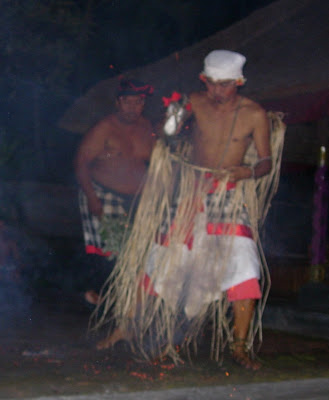
There is a lot more to Bali than what the average tourist gets to see. The Kecak dance is probably the first cultural activity that a tourist goes to. Next is the Barong dance. After these two dances, you probably feel you've had enough of depictions of stories from the Ramayana but you shouldn't miss the Fire Dance which is really quite spectacular. Before the Fire Dance begins, a young male devotee is blessed by a Hindu priest. By the way, all these dances have strict religious significance and they can only be performed after the participants are blessed by a Hindu priest. I once attended a Kecak dance which could not start on time and had to be delayed for half an hour because they couldn't get a Hindu priest to conduct the blessing. Let me go back to the Fire Dance. A large bonfire is built at the centre of a clearing and the boy then prances around on a toy horse (it's usually made of straw and metal) and he goes in circles and very soon he's in a trance-like state. He then begins to kick the bonfire and helpers erect barriers to stop the burning coal that is flung all about from hurting the spectators. The boy continues to dance and kick the bonfire until everything is extinguished.
 Fire dancer receiving a blessing from a priest
.
The boy is careful to avoid stepping on burning coals and in the right pic, you can see how difficult it is with burning coals strewn all over the clearing.

Below is a more experienced fire dancer. He kicked all the flaming coals with a great deal more energy and he played the part of an entranced spiritualist much better. At the end of the dance, I chatted with him in Bahasa Indonesia and I was surprised to see that he truly believed he was protected by the Dewi, a goddess. I was curious why it was a goddess and not a god which protected him but I didn't dare to ask for fear of causing offence. I didn't want him to throw some remaining embers still smouldering at me! But if you look at the photograph I took below, you can see that his feet looked burnt.
.

There is much more to Bali than the beaches. True, the beaches are beautiful but then, so are most beaches. You won't ever find gravel beaches like what you see in some parts of England. No, our beaches are always beaches of fine sand and it's always the same breeze, the same coconut trees and the same blue sea. Kuta beach used to be lovely but it became overused. You get to see the sun rise in Nusa Dua and Sanur and the sunset in Jimbaran and Seminyak. But then one might argue that you get to see the sunrise and the sunset on beaches outside Bali too and so what is there for Bali to offer?
.
Left: sunset at Jimbaran beach                  Right: sunset at cliff near Uluwatu.

Next we have the temples.  Naturally, on the Island of the Gods, one expects to see temples. The temples of Bali are unique but once you've seen them all, what else is there? Uluwatu is really a must-see but you've got to be careful with your glasses and other possessions. Here's where monkeys are trained to steal your glasses or camera and you will be compelled to pay someone (and he's probably the monkey's trainer) to retrieve your possessions for you for a fee. Tanah Lot is beautiful only because it's out there in the sea and is only accessible at low tide. But tourists aren't permitted in the temple so there really is no point waiting for low tide unless you want a photo of the temple at low tide. Other temples that aren't that commonly visited include Pura Gunung Kawi which is really quite impressive and Goa Gajah which is quaintly pretty.

 .
Left: sunrise at Uluwatu                           Right: sunset at Uluwatu.

.
Left: Low tide at Tanah Lot                         Right: Gunung Goa.

I will not post photos of many other temples in Bali which aren't really all that special. Besakih is always mentioned as a must-see but I really don't recommend it unless you've been to Bali many times and you feel something is missing if you don't see it. Pura Gunung Kawi (photo below) is far more impressive even though my photo doesn't do justice to the splendour of the place.


Sometimes, the name of a temple sounds just like something that comes out of an Indiana Jones film and I set out one morning in Ubud for the Sacred Monkey Forest. I was eager to see the Temple of the Dead. But after trudging deep into the Sacred Monkey Forest which is actually more like a park with dense foliage, I saw this nondescript little building (see below left photo) and that was my Temple of the Dead. But true to its name, the Monkey Forest is at least full of monkeys (right photo below) but my Temple of the Dead didn't resemble by any stretch of the imagination the kind of temple Indiana Jones would steal the magical eye of Kali from. Not in the least.

.

And if you are wondering why I have a sarong wrapped over my trousers, many temples in Bali require visitors to be dressed in a sarong or a sash. It makes sense to buy a sarong and wear it for all your temple visits.

Now that I've dealt with the beaches,  the culture and the temples, what more is there? After all, I've stayed in hotels, villas and resorts in Kuta, Sanur, Nusa Dua, Ubud, Jimbaran and Seminyak and I have visited many other places which I've not stayed overnight in. So, really what more is there? Wait for Part 2 and you will see how much more there is to Bali that the average tourist can't possibly even dream of. Before I conclude, my "Bali Part 1" would not be complete if I did not talk about an event I attended in June 2005. It was a huge event organised by the Indonesian government and which was attended by State dignitaries. There were festivities and dancing on a large stretch of Kuta beach. Security was tight and the ceremony which was called "Kuta Karnival" was designed to show the world that Bali and specifically Kuta which was bombed by Muslim terrorists just three years before had  bounced back to life and Bali was once again the ideal tourist destination.

.
There was dancing everywhere.

.
Indonesian dignitaries releasing turtles into the sea as a mark of peace.

Sadly, 3 months after this event, Muslim terrorists launched a second Bali bombing simultaneously in Kuta and Jimbaran, killing more than 20 people and injuring more than a hundred.  For the past 9 years, Bali has been peaceful and let's hope it stays that way.

I will soon continue with Part 2 but like I've said, if you are easily troubled by vivid images of dead bodies and of villagers armed with machetes heading in my direction, please do not read or view the photos in Part 2.