Friday, February 7, 2014

Proof that MOE's English experts ruin students' English

ENGLISH AS IT IS BROKEN and ENGLISH AS IT IS BROKEN 2 are two grammar books published by the Straits Times, the Ministry of Education (MOE) and the Speak Good English Movement. They are both in a question-and-answer format. The questions on grammar come from the general public (usually school students) and the answers are provided by a panel of English language experts from MOE.

It is most unsettling when I see a student who is correct in his grammar being told by the panel of experts that he is wrong and he is asked to follow a sentence structure which any English-speaking person must know is incorrect. When I see this (and there are quite a few examples in both books), I can't help thinking that students in Singapore would be so much better off if MOE dismissed its panel of experts.  Let me give an example from ENGLISH AS IT IS BROKEN 2.

Here's a question from a school student followed by the answer given by the panel of English experts from MOE.


The student wrote, "Do you know who the inventor of the camera is?" and his teacher changed that to "Do you know who is the inventor of the camera?"

MOE's panel of English specialists agree with the teacher.  Suspend your horror for the moment. A reader was uncomfortable with the answer and he wrote to the panel of experts to say that "Do you know who the inventor of the camera is?" is correct.


Like most people who speak good English but do not know the specific rules of grammar, the reader can tell that the experts are wrong but he doesn't know how to explain why they are wrong. 

Here's the panel's reply.


Any right-thinking person must know that the panel of "English experts" are spewing rubbish form their mouths.  What really annoys me is the fact that the experts must know that they are making up their own rule. Such a ludicrous rule cannot have come from any grammar book. I am tempted to question their honesty because in my book, anyone who makes up his own grammar rule to justify his erroneous statement must be deliberately deceptive. Here we have an honest reader who is saying that he "feels" the panel is wrong but he can't quite put a finger to it. The decent thing to do is to show the reader what grammar books say about such a sentence structure and if the books show that the experts are wrong (as any respectable grammar book most certainly will show that), they should admit they're wrong. Instead what the panel does is to make up their own rule. 

Any "natural" English speaker (and he does not have to be a native speaker) must know that the experts are wrong here. It's wrong to say "Do you know who is the inventor...?" The correct form is "Do you know who the inventor is?"

What MOE is saying is when you remove "Do you know", the clause that follows must be able to stand on its own and since you can't say "Who the inventor is?", the correct question must read "Do you know who is the inventor?" There is no such rule in grammar and I'm positive it was concocted by MOE's panel of experts. You only have to look up any grammar book and you will see that no such rule exists.

I am reluctant to make any reference to a grammar book because this is so elementary and I understand from my own children that this is something all primary school kids know. But there's no harm picking a few examples from a grammar book. I'm now seated in my study and right in front of me on my table are five grammar books. Quirk's A Comprehensive Grammar of the English Language weighs a ton and I'm not going to break my arm for MOE since they don't even thank me for this. I'll refer to The Oxford Guide to English Grammar which is much smaller. You can use any grammar book you have. What we are looking for should appear in the part of the book on basic sentence structure.

The rule is very simple. Let me paraphrase it for ease of comprehension. The usual subject-auxiliary inversion that we see in questions does not apply in an indirect question where the question is put into a sub-clause beginning with a question word such as, in our case, "what". It's the same rule (ie non-inversion) if instead of a question word, we have "if" or "whether". The Oxford Guide gives the following examples:

We need to know what the rules are.
Could you tell me where Queen Street is, please?
Do you know when the train gets in?

can't help wondering what kind of teachers MOE produces if their English language experts don't even know such a basic grammatical rule. Don't forget that the student who asks the question wrote the correct sentence but was marked wrong by his teacher. But my children assure me that all primary school English teachers know this rule so at least I'm comforted that primary school English teachers aren't as clueless as MOE's panel of English language experts.

What MOE should do is to sack its entire panel of English language experts. If MOE needs any evidence to support their dismissal as just and lawful, simply adduce as evidence pages 78 and 79 of ENGLISH LANGUAGE AS IT IS BROKEN 2. If they can't remember the page number, any page will do and the first volume is just as bad as the second. That's how bad they both are.  Never before in my entire life have I seen a grammar book that is so disgracefully wrong on almost every page as these two books by MOE's experts.


IMPORTANT NOTE [7 Feb 2014; 8:54pm]:  WHAT EXACTLY IS THE INVOLVEMENT OF THE MINISTRY OF EDUCATION IN THESE TWO APPALLING BOOKS?

In English As It Is Broken, the name and logo of the Ministry of Education appear clearly on the back cover. On the Acknowledgements page, gratitude is expressed to "the Ministry of Education for the panel of English Language specialists to answer and comment on the questions and queries sent in by the public, and the support given to the publication of this collection of language gems".


In English As It Is Broken 2, the Ministry of Education does not seem to feature at all. The English Language panel are individually named and a search on the internet seems to indicate that they are connected  to the Speak Good English Movement and I'm unable to see any link to the Ministry of Education.  Is it possible that the involvement of the Ministry of Education is confined to only the first volume and not the second? Since both books are disgracefully riddled with outrageous errors, any involvement in either book is still a huge embarrassment for the Ministry.


NOTE:

I have given other instances of MOE's shocking English errors and if you are interested, you can click on the following:
1. Have/has and other errors
2. Cooking Up Two Rules and 
3. Stick No Bills.
4. An Appeal to the Ministry of Education.

For a full list of grammar errors made by MOE, the Speak Good English Movement and other language teachers, please click here.

Thursday, February 6, 2014

MOE's Language Expert Blunders Again

Many times have I purposed in my heart to say no more on this subject. Some friends of mine have told me that they are bored by my posts on the subject of language but there are others who find them amusing. As a compromise, I will be sparing in my words and I will keep this post short.

On page 156 of the book written by the "English Language experts" of the Ministry of Education (MOE) in Singapore called ENGLISH AS IT IS BROKEN, the question is asked if we should say "A friend of John" or "A friend of John's". Here is the answer given by the language experts.


It is very hard to find in this excerpt anything that is of value to learners of English because EVERYTHING in it is wrong. I don't even know where to begin.

I really wonder who wrote this and whether he's still in MOE's employ. But then again, we can't put the blame squarely on his shoulders. What has everyone else in MOE and the Speak Good English Movement been doing all these years? This book was published in 2007 and it has undergone 9 reprints. The foreword was written by the deputy editor of the Straits Times and the preface by the then Chairman of the Speak Good English Movement. The Straits Times, the Speak Good English Movement and the MOE are all jointly involved in the publication and they should all share the same accountability even if the "expertise" came from the "English language specialists" from MOE.

OK, let's begin with the beginning. The first sentence tells us that John is a pronoun. This is not a typographical error because towards the end of the excerpt, it says one more time that "John" is a pronoun.  "Hence, the pronoun 'John' in the sentence will be in the possessive form..."

Anyone who has been to primary school must know that "John" is a proper noun, not a pronoun. Or could it be that when the writer typed the words "proper noun", there was a technical glitch and the letters P, E and R  in "proper" were deleted, leaving behind "pro   noun" which fused together to read "pronoun"? And it happened twice?

The second sentence in that excerpt is simply disgraceful.  Here, the writer comes up with the most ludicrous grammar rule I've ever seen in my entire life. This reminds me of what I wrote 3 years ago about people who cook up their own grammar rules. Please click here if you want to read it. One thing I've learnt from dealing with grammar charlatans when they come up with rules that they hope people won't bother to try out is to put it to the test and expose their linguistic quackery.

Before going on, I have this to say. Charlatans usually clutter up what they want to say with unnecessary statements to confuse their readers. Look at this sentence which is nothing more than inane verbiage:


Who cares what you call them? Sometimes, a grammarian is compelled to divide groups into A and B and so on but you only do that if it's necessary to refer to the different groups later on. Why then did the writer pick a few items and group them as "Group A determiners" when it's not necessary to do that? It leaves the reader dangling uncomfortably in midair as he looks out for a Group B and a possible interaction between the two only to realize at the end of the excerpt that the writer's Group A has no real function at all.  [Note: some of you may think that there is more that the writer says apart from what I've posted above but that's incorrect. There is no Group B and the first photo above is all that the writer says on the subject].

What he's saying is simply that you can't say "a John's friend" and this is something everyone knows. But the writer, by making up a non-existent rule that you can't put together an article and a possessive, has got it all wrong. I can think of many examples where you can have an article followed immediately by a possessive.  "The boy's bag" is a good example.

Someone who claims to teach English grammar should not cook up a non-existent rule just to sound learned especially if there is no such rule and anyone can come up with perfectly grammatical examples to show that the rule cannot stand.

The writer next cooks up one more rule which in fact is the ratio decidendi of this entire passage and so let us pay close attention to what follows.

This is what he says and I will, where possible, stick to his very words -

Because we cannot say "a John's friend", "we have to use the following structure:  Determiner + noun + 'of' + possessive". The writer then goes on to make it very clear that the rule is inflexible. This is what he says in conclusion:

Hence, the pronoun "John" in the sentence will be in the possessive form and not the object form. So it will be a "friend of John's" and not "a friend of John".
That, I'm afraid, is one of the most misconceived and ridiculously flawed formulation of a rule of grammar that I've ever seen.

Notice that the writer has not once given a reference to a respectable grammar book to support this rule of his. That's because he cooked the rule up himself and all grammarians are not with him on this.

I will give examples which I have taken from various authoritative works, especially the works of grammarians on this subject to show that the formula determiner + noun + 'of' + possessive is not an inflexible rule as the writer suggests.

Robert Allen: "a friend of my father".
Quirk, Greenbaum, Leech & Svartvik: "the daughter of Mrs Brown"
RW Burchfield: "niece of her late husband"
King James Version: "a servant of God, and an apostle of Jesus Christ".

It behoves anyone who styles himself an "English language specialist" to resist the temptation of making up his own rules of grammar. I have read enough of the two books written by MOE's panel of specialists to know that they really don't know a thing about grammar but that's fine. I have no quarrel with anyone who does not even know what a pronoun is. There are a lot of good people who don't know these things. I don't even mind if he wants to call himself an English language expert. That's his prerogative. But he must have the decency not to write books on grammar and make up rules that don't exist and that can easily be shown to be totally wrong. But what if it's his job to teach English to students? His own honour and dignity must compel him to leave a vocation to which he's clearly not suited.


Editor (4 Jan 2018): I actually stumbled on the source of this error of the Speak Good English Movement two years ago and wrote a blog article about it. Because the Movement is ignorant of the terms used in most grammars, it misapplied a grammar rule and the result is this ridiculous error.

Wednesday, February 5, 2014

STICK NO BILLS

I have often noticed that those who pride themselves as the guardian and watchdog of standard English in Singapore don't really know much about the language in the first place. They have no knowledge of grammar and usage but what they seem to have (at least some of them) and in abundance too is an aversion to anything Singaporean. When they see any sign or poster in Singapore, they are very quick to assume it contains non-standard English. The question that is always on their lips is, "Are foreigners (who use standard English) able to understand what we say?" That is the main goal of the Speak Good English Movement - that we must speak a language that is understood by foreigners from other English-speaking countries.

That is a lofty goal and nobody can fault them for it. My only complaint is simply that they are not qualified to teach Singaporeans English, and I have shown enough evidence of it in my various blog posts, two very recent posts of which can be found here and here.

What happens when our language watchdog sees a public sign? The first thing he does is to ask himself if it's "typically Singaporean". If it is, I suspect he will immediately dismiss it as Singaporean pidgin English or "Singlish" and insist that it be re-written in what he understands as standard English. This is probably what happened when our language watchdog encountered the sign "STICK NO BILLS" in Singapore.

I attach here a photograph from page 27 of ENGLISH AS IT IS BROKEN, a book published by the Speak Good English Movement and the Ministry of Education whose "panel of English Language specialists" were generous enough "to answer and comment on the questions and queries sent in by the public".


As you can see, this is a sign by the Land Transport Authority . The panel of English Language experts from the Ministry of Education state quite categorically that it is quite common to see this sign in Singapore but the language is "not something that a foreigner would be able to understand".

I really don't know what to say. Don't the language experts from the Ministry of Education travel or read books that aren't published in Singapore? Some things are just too stupid for words.  I will just say it all in pictures.

Here is a 19th century cartoon.


A street boy is warning another boy not to stick bills on the walls because of the STICK NO BILLS sign (see top right hand corner). I don't think the language experts from the Ministry of Education will say this is a Singaporean cartoon and the street is Change Alley in the 19th century?

Here's another photo of the Royal Academy of Music in London.  Look at the red arrow I've drawn on the photo.


It's of course possible that they were expecting hordes of Singaporean tourist who might just stick bills on their walls and a bit of Singlish wouldn't harm, would it?

And here are examples of STICK NO BILLS signs posted all over India. I like the second sign that also prohibits spitting. I wish I could say it's a sign found in China and increase my list of countries where Singlish is used but no, it's from India.


Tuesday, February 4, 2014

An Appeal to the Ministry of Education

Just a day or two ago, I wrote a blog post suggesting that the Speak Good English Movement be scrapped. I gave a very good reason for the suggestion. From the articles published by the Movement and stored in the archives of the National Library, it can be seen that whoever wrote the articles on English grammar is undoubtedly clueless about even the rudiments of English grammar and usage. The many answers he provides to questions on grammar are not only wrong, but outrageously so.

From the searches I did on the internet, I discovered that the Movement is involved in the publication of two books on grammar which are ironically called ENGLISH AS IT IS BROKEN and ENGLISH AS IT IS BROKEN 2.

I may have sounded facetious in my earlier post which is not surprising since this is my personal blog and I wrote mainly for my own amusement but the more I thought about the matter, the more troubled I became.  Although I had promised myself to leave the matter alone, I felt strangely uneasy for the greater part of the day and this afternoon, I found myself unable to resist buying both the books. A mere cursory glance through them is enough for a careful reader to conclude that both books are aptly titled - English as it is broken by the writers.


These are books that purport to teach Singaporeans English grammar and to help us speak and write standard English but what I have seen so far in both books are errors heaped upon errors. And I'm not talking about the disputed areas of grammar where different grammarians hold different views on the subject. The errors in both books are errors that no educated person would make and they immediately call into question the suitability and qualification of the writers of these books.

My initial plan was to highlight the errors in my blog but after going through a few pages, I could see that it would be a truly daunting task. There are far too many errors and I have neither the time nor the energy to expose them all. And I'm not talking about minor mistakes. These are huge egregious blunders that no one who has a reasonable command of the English language should make.

It's very hard for me to determine who the writers of these deeply flawed books are. The articles in the archives of the National Library are all headed with the logo of the Speak Good English Movement and I thought when I wrote my blog post yesterday that the Movement was solely responsible for these mistakes. Having looked at these two books, I now understand that apart from the Speak Good English Movement, the Straits Times, the National Library Board and "English Language specialists" from the Ministry of Education are all involved in the writing of the books.

I should make it very clear that I have no political agenda. As I have stated many times in the past in various posts in my blog, as far as education goes, Singapore has a lot to be proud of as the recent PISA test only serves to confirm. Very few countries can boast of an educational system that even comes close to what Singapore has achieved and all this is only made possible by the clean, efficient and responsive system of governance we have and the rigorous emphasis we place on excellence and meritocracy. As I have said repeatedly elsewhere in my blog, Singapore indeed has the winning formula.

However, these two books are the only blot on our educational escutcheon and we should remove them immediately. I understand that both books remained best-sellers in Singapore for months and they are hugely popular in schools and countless unsuspecting teachers and students have read them to their detriment. The mistakes I have exposed in my previous blog post are but the tip of the iceberg. Having gone through both books more carefully, I am persuaded that they cannot in any way serve the objective of the Ministry to improve the standard of English of students in Singapore. On the contrary, they will only perpetuate errors in grammar and usage and create new errors which Singaporeans would not have made if they had not read the books.

Errors in books are usually few and far between and even then, they are usually corrected in the first reprint. The errors in these books are not few.  By my estimate, one is unable to go through two or three pages without encountering some very serious mistakes in grammar. That is disgraceful for a book that purports to teach grammar. These two books were published in 2007 and 2008 and they have undergone numerous reprints and surprisingly, none of the errors has been corrected. But the errors are of course too many for them to be corrected effectively. It would make more sense to discontinue publication of these books and to warn readers how terribly flawed they are.

Ever since Fowler wrote his first grammar book in the early 20th century, the world has never been short of good grammar books. We don't need these two books at all. I appeal to the Ministry of Education whose "English Language specialists" are said to have contributed to the writing of these books to find some means of neutralizing the impact they have on our students if it's not practicable to recall all copies of the books and have them incinerated.

Monday, February 3, 2014

Why Singapore's Speak Good English Movement Should be Scrapped

If you don't know much about grammar and you are given the task of telling Singaporeans what common grammatical errors they make and how they should correct them, what would you do? The obvious thing to is to pick a sentence that is so obviously wrong that no Singaporean would construct in the first place and tear it apart and publicise that all over Singapore.  That's precisely what the Speak Good English Movement folks have done in this advertisement that has almost become an icon of the Movement and appears even in wikipedia.


I find such an advertisement which appeared in some food centre in Singapore incredibly insulting to Singaporeans.  I do not know a single Singaporean who says "Borrow me $5 can?"  I've spoken to many Singaporeans and none of them knows of anyone who speaks that way.  Such an ad ridicules Singaporeans most unfairly because that is not how the average English-speaking Singaporean speaks.  Absolutely nobody speaks this way.  If a Singaporean is totally uneducated (and there aren't many of them here), he probably speaks his own language, ie one of the Chinese dialects, Malay or Tamil.  Posting such an ad in a public place would only give non-Singaporeans the false impression that Singaporeans really make such shocking mistakes in their normal speech.

In a previous blog post, I mentioned how the then chairman of the Speak Good English Movement Committee made the ludicrous suggestion that Singaporeans could not pronounce the word "cement".  I showed in that post that the problem lay solely with him and those of his ilk - people who are pretentious and who try so hard to sound un-Singaporean that they mispronounce words that even uneducated Singaporeans have no trouble with.

What good is the Speak Good English Movement to Singaporeans?  What purpose does it serve?  I will argue here that apart from insulting Singaporeans and giving foreigners the false notion that we in Singapore are unable to communicate in English (which may very well ruin investment opportunities here), those in the Movement who profess to teach us good English are not equipped to handle even the rudiments of English grammar.  In that earlier post of mine, I demonstrated how they got everything they said about grammar wrong.  If you have not read that post, I urge you to click here.

Although I laughingly concluded in that earlier post of mine that the Speak Good English Movement had a statistical 100% failure in English grammar, I felt that wasn't entirely fair even though they made two points on grammar and they got both of them wrong.  As any statistician knows, you need a larger sample size for an accurate statistical reading and being a decent and fair-minded chap, I decided to look for something more that the Movement has written.  I went to their website and this was what I got.


The website has been under maintenance for a long time.  But I just discovered today that the National Library has archived all the past articles of the Speak Good English Movement.  Each article usually consists of only a few sentences and follows a simple format. It begins with a question on grammar which is followed immediately by an answer.  I have looked at random at three of their articles and I will deal with all three here.

Let's begin with


ARTICLE NO. 1


If you don't trust my screen-capture and want to read the original article as archived by the National Library, click on this link.

It began with a promising start.  It's correct to say that "none" can be followed by either a singular or plural verb.  If the writer had ended there, it would have been perfectly correct.  But something possessed him and he went on his own foray into a territory which is obviously alien to him.  He went on to suggest that you follow the proximity rule and he concludes by saying that "none of the mixture" should be followed by a singular verb while "none of the ingredients" a plural verb.

That is incorrect.  Strict grammar rules require "none" to be followed by a singular verb and so both examples given should have a singular verb. There is no dispute among grammarians here. As long as you use a singular verb, you are correct. However, the question arises as to whether you can say "None of the ingredients are left". Most grammarians today agree that the plural verb is all right. Some, for example, Quirk, et al in A Comprehensive Grammar of the English Language while acknowledging that opinion is divided on the plural verb, are prepared to say  that it is "generally accepted even in formal usage." However, The Oxford Guide to English Grammar insists that "the plural verb is more informal". Hence the "common guideline" given by the Speak Good English Movement is nonsense.


ARTICLE NO. 2


Here's the direct link to the article in the National Library's archives

What I would really like to know is what dictionary the writer of this article used that describes an "outpatient" as "someone who receives treatment in an hospital...". I have looked into my many dictionaries and I even borrowed my grandfather's old dictionary that was published in the early 20th century but I don't see "an hospital" anywhere.

There was a time when respectable writers wrote "an historian" and "an hotel" but never "an hospital". There is evidence of the continued use of "an" immediately preceding words such as "hotel", "habitual" and "historic" but NEVER "hospital". There is a reason for this but I won't spend my time on this inconsequential bit of history.

The reason why I bring this up is it will explain the hideous error in the last sentence: "...an 'inpatient' is someone who stays in hospitals..."

As I have mentioned before, I love to get into the psychology of the individual.  I want to know why the writer wrote "hospitals", ie in the plural.  I'm sure the writer did not mean that you could only be an inpatient if you stayed in more than one hospital.

This is my conjecture but I'm sure I'm right.  The writer must have consulted a truly weird dictionary that says "an hospital".  When he wanted to write "...an inpatient is someone who stays in a hospital", he balked at the thought that he'd be using a different article from that used in his wacko dictionary. But he couldn't get himself to write "an hospital" for it really does sound daft.  He racks his brains for a solution but alas, he's rather deficient in imagination.  In desperation, he turned "hospital" to "hospitals" which happily obviates the need for a pesky article.  Poor chap.  He should have known that "hospital", like "school", is one of those self-confident nouns that can exist quite contentedly without an article.  It would have been perfectly all right if he had written, "...someone who stays in hospital...".


ARTICLE NO. 3


For the link to the original article in the National Library's archives, click here.

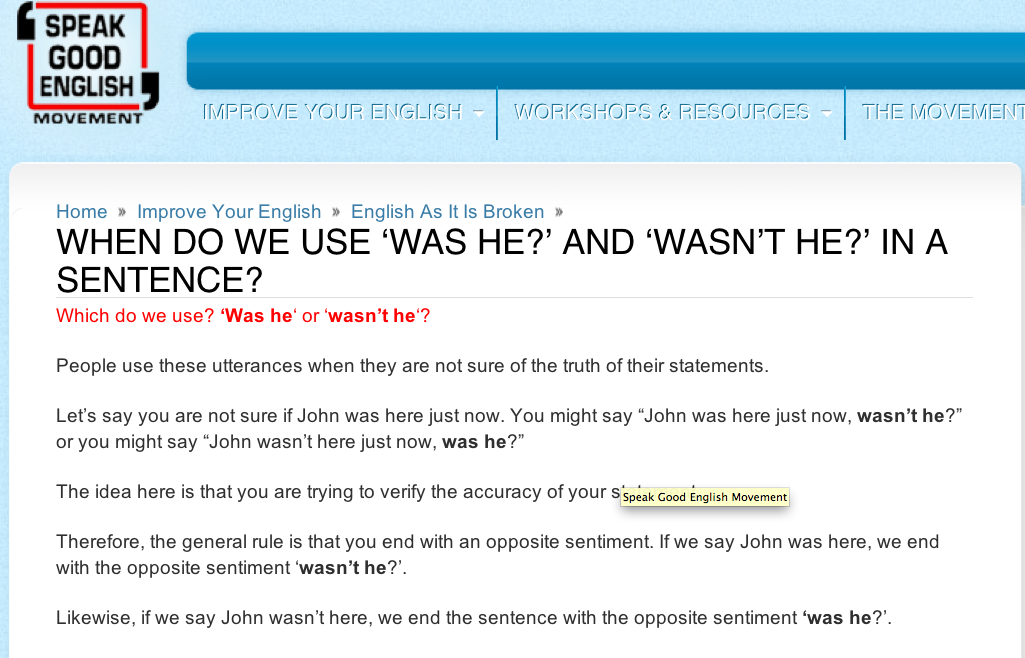
"People use these utterances when they are not sure of the truth of their statements."  As I have said many times before, I don't care what word a person uses as long as his meaning is clear.  But when someone from the Speak Good English Movement superciliously arrogates to himself the authority to tell the rest of us what grammar is all about, I do care a lot if he does not use the correct term. "Utterance" has different shades of meaning and can be used in different senses.  It can mean the action of uttering something.  It can also mean a person's power of speech or his manner of speaking.  It also means that which is uttered, a spoken or (occasionally) written statement or an articulated sound. In Linguistics, it has the special meaning of an uninterrupted chain of words spoken by someone eg "the utterances of children".  But an "utterance" is not the best word a grammarian or a language teacher would use to signify what the writer intended.

Now, I'll go into the psychology behind the error.  For the sentence "John was here, wasn't he?" why on earth did the writer refer to "wasn't he?" as an "utterance"?  Again, I can only hazard a guess but I'm positive I'm right.  In grammar, "wasn't he?" in such a sentence is called a question tag. As I have shown in this post and my earlier blog post about the Speak Good English Movement, I think I can't be faulted if I say that a working knowledge of grammatical terms is, in my view, not one of their strong points. Now put yourself in the shoes of someone who doesn't know it's called a question tag. How do you refer to it then? That's the infuriating thing about grammar. If you don't know its many terms, it's very hard for you to tell others they are wrong and telling others they are wrong is just what these people love to do.  So, what should our grammarian wannabe do?  What other words can he use that mean a question tag? The next best term which isn't as precise as a question tag is of course a clause. Now, our poor grammarian wannabe is confused. Is it a phrase or a clause? In grammar, they have different meanings. After puzzling over this for a couple of minutes, our grammarian wannabe probably decided to chuck it all and just settle for "utterance" which is of course not just too general and ugly but amusingly so.

It was only after I had examined these three short articles by the Speak Good English Movement that I realized that they had compiled all these appalling articles into not just one but two books aptly called English as it is Broken and English as it is Broken Part 2.

I asked myself if my readers might think I was a little unfair to the Movement if I didn't make at least a reference to one of the books and so I did a search in google for one of these books to see if perhaps they might have taken greater care with their book than they did with their website. Everyone knows how slovenly we all are on the internet but a book is different. You have to proofread it countless times before it is finally sent for publication. So I searched on google and sure enough, I found a few pages of the book in google.  I screen-saved the first little paragraph and I told myself that this would be the final bit of write-up I would bother to read.  If there was nothing wrong with that excerpt, I would post it here and tell the world that the Speak Good English Movement isn't always wrong on grammar.

Here is what I screen captured from the book as displayed on google books.


.
There you have it. Need I say more? Who or whom? They have a 50% chance of getting it right and of course they got it wrong. There is no dispute among grammarians here.  The answer given by the Speak Good English Movement is usually cited in grammar books when they want to give an example of an ungrammatical sentence. It is placed directly under the section "Whom used ungrammatically for who" in Burchfield's edition of Fowler.  Robert Allen has a similar section on this and attributes the error to hypercorrection. The reason for the error is immaterial. The fact is this book which purports to teach Singaporeans good English actually perpetuates incorrect grammar and I don't think I'm unkind if I hold the Speak Good English Movement fully accountable for this.

In my previous blog post, I declared that the Speak Good English Movement had a 100% failure. But it was a two out of two failure and the sample size was too small.  I have now examined four other write-ups (including a book they published) and again every one of them has some disgraceful error.

I have nothing against the Speak Good English Movement and I'm sure the many people who are involved in this campaign and who have worked tirelessly are lovely people with the best of intentions.  But alas, they are not qualified to talk about grammar.  If indeed the people of Singapore have such a poor command of the English language that we need a movement to address our shortcomings, the people who have made all these embarrassing errors on grammar and usage are not the ones who should teach us English grammar.  Isn't it painfully obvious that they know far less than the rest of us?  The moment they attempt to delve into the intricacies of English grammar they embarrass themselves by displaying their ignorance and worse, they teach unsuspecting Singaporeans to make ridiculous grammatical errors they normally wouldn't make.  From what I have seen, the only time the Movement gets anything right is when they cook up fanciful errors that nobody ever makes such as what we have seen on that large and expensive poster in food centres which they proclaim loudly to be incorrect. Not even a fool needs to be told that "Borrow me $5 can?" is wrong.  If that's all they can do and they blunder in all aspects of grammar, shouldn't we just disband the committee and scrap the entire movement?

For a complete list of all the links to my blog posts on the many other errors made by the Speak Good English Movement, please click here.

Recent related post on grammar: Why Jon Gingerich's grammar checklist is wrong

Friday, January 31, 2014

Cultural Guilt

What I'm going to say here can be viewed by some as insensitive and even offensive.  Before I begin, I should stress that I will only confine myself to my own culture and I will not talk about any other culture which I know very little about but I'm sure they have the same problems that I see in my own culture.  If you belong to a different culture, you may want to examine it in the light of what I've said and see for yourself if parallels can be drawn from this.

In my culture, we are always told that we are not good enough.  We are not worthy, we are nothing, we are fallen creatures, wretched are we and so on.  The idea behind this self-abasement is of course to pave the way for us to depend on God.  In the words of St Paul, we must decrease while Jesus must increase.  We are told that we can do no good and despite being saved by Christ, we continue to "sin" and we continue to disobey God.  Of course, to make sure that we always appear to be in the wrong, my religion lists a lot of perfectly harmless and natural actions as sinful and worthy of hellfire.

I'm not sure what deleterious effects such a culture has on the minds of children.  I have mentioned perfectly harmless deeds which are considered sinful and totally depraved and wrong and I'll talk more about that now.  When I was in secondary school, there was a boy who took his religion a little too seriously.  One day, he asked me what I thought of "the sin of masturbation".  I jokingly told him it was only a sin if he didn't say grace before it.  As you can imagine, he was furious with me for saying that.  Seeing how facetious I was with that which he considered sacred, he naturally didn't consult me on matters of the faith.  But I heard from other boys that he had a lot of "issues" with what churchmen sometimes call the sin of Onan.

Anyway, we soon went our separate ways and we lost contact for some years.  I knew he'd gone to medical school in a different university from mine and he was doing well.  I heard too that he had become insanely religious but I didn't ask for the details.

It was either in my second year or third year at uni when I got shocking news from a former schoolmate that something dreadful had happened.  This friend of mine (the one with serious issues about sin and other medieval concepts) had been suffering from depression for some time and his body was found floating in a river.  He had taken his own life.

I remember feeling paralysed by the news.  I put down the receiver, slumped in my chair and memories of our past conversations came rushing back to me.  Should I have talked him out of his deep belief in silly concepts of sin and retribution?  But I was only sixteen at the time when he spoke to me and making a joke out of the whole situation is just what you would expect a teenager to do. Besides, I wasn't a trained counsellor.  And how would anyone know that nonsensical prohibitions placed by an ancient religion would affect him with so much guilt?

There were many questions in my mind.  Chief of them was why are there no verses written in the Holy Gospels that clearly tell all these people who take their religion so terribly seriously that as long as you don't harm anyone and yourself, it's ok if you want to do anything you feel like doing?  I didn't think of it then but in today's world, I can think of many other areas of supposed "sin" that conservative Christians mark out as an abomination unto God.  I'm thinking of course of the lifestyle of our gay and lesbian friends.  They don't harm anyone by their love and relationships and is it right for us to say they can't do it because it's a sin?  Just as my friend could have taken his life because of a guilt the church drummed into him all his life over something as insignificant as masturbation, there may very well be gay and lesbian Christians who feel the same guilt for being what they were born to be.

Today is the first day of the Chinese New Year and the beginning lines from the 三字经 which I have committed to memory and which is also a part of my culture somehow spring to mind:


人之初
性本善


The 三字经 is directly contradictory to Christian teachings.  Man is born good and our natures are similar but it's our habits that make us differ from one another.  In Christianity, it's just the opposite. Man is NOT born good. Every new born baby is tainted with what is called "original sin".  He is guilty of the sin of Adam and he's condemned to hell unless he subsequently accepts the "saving grace" of Jesus.  Even after he is "saved" he will continue to be wretched and sinful and he needs the grace of God and God's constant forgiveness in order to be cleansed and absolved.


Ever since I was a boy, I was told that if my two cultures clashed, it was the Christian culture that should prevail.  The 三字经 is at best the wisdom of man but the Bible tells us that the wisdom of man is folly to God.

Every culture has its own wisdom and I'm not so quick to dismiss the wisdom of the 三字经 without further consideration.  The 三字经 has the added advantage that it's not dogmatic.  It doesn't tell you that you have to accept its wisdom or you'll burn in hell.  It's just one of the many Chinese philosophical works and it's not even one of the six traditional Confucian texts.  There is no compulsion in it.  It's a classical work and you can read it if you want to or throw it away if you are so inclined.  It's not sacred or religious.

The Bible, on the other hand, is the word of God.  It's sacred and you are told to accept it or burn in hell.  It's sometimes very clear especially when it wants to condemn a particular action which it terms as "sin".  But in other areas, it's frighteningly ambiguous.  I recall a comedy I once saw about a reenactment of the Last Supper.  When Jesus said the Eucharist words, St Matthew asked him to be precise - does the bread become his body or just a symbol of his body?  When Jesus dithered, St Matthew fumingly told him that wars would be fought and lives sacrificed because of a theological disagreement over the doctrine of the Real Presence.  And if he was really God, surely he could look into the future and see the chaos caused by this ambiguity in his words.  It ended with Jesus not giving a straight answer and St Matthew leaving the Upper Room in a huff.

The church will be the first to say that life is sacred.  We know from history that wars were fought and lives lost over silly theological disputes.  I remember being so emotionally moved when I saw as a boy a movie about the beheading of Lady Jane Grey.  She was asked a few religious questions and giving answers that pleased her captors could mean that her life would be spared.  She knew what the "correct" answers were but she chose to give answers that accorded with her religious conviction which meant certain death.  One of the questions she was asked was how many Sacraments there were and her answer sealed her fate.

If one of the Evangelists had written in a Gospel that
"Jesus took the disciples to the mount and said to them, 'Verily, verily, I say unto you.  There are x number of Holy Sacraments.  Woe betide any man who declares that there are any number of Sacraments apart from x in number.' And the disciples did marvel at how wise the words of Jesus were that there are x number of Sacraments, and not a jot more or fewer", 
there would have been no disagreement on this question.  And no killings, no beheadings and no unnecessary deaths.

The 三字经 has no blood-splattered history of wars and killings.  It's just philosophical wisdom and you can accept it or reject it for all anyone cares.

As we celebrate the Year of the Horse, let us remember that when we are dealing with ancient texts and it does not matter if it's the Bible, the Quran, the Veda, the Sutras or the 三字经, we should carefully pick and choose what's right and ignore that which we know deep within us is unkind, unloving or just obviously not right. Sometimes, ancient writers have a lot of baggage that we know nothing about and they can say monstrous things that any right thinking person today would dismiss as utterly immoral.

Saturday, January 25, 2014

Understanding Anton Casey

If you haven't heard of Anton Casey, you probably don't live in Singapore.  A few days ago, the New Paper devoted a full front page to his story, complete with a photograph of his face.  His infamy is now reported in major newspapers all over the world.  You may read about him in the Times, the Guardian, the Daily Mail,  the Independent, the International Business Times and the Australian.


Photo from the Daily Mail


What really puzzles me is what motivated Casey to be so contemptuous of poor people. He has said that this was the worst mistake of his life. But was it a mistake? I really don't think so. I think a person who taunts and laughs at poor people publicly cannot say that he "has made a mistake". What he can say is although he really hates and despises the poor, he should not have done so publicly because the repercussion on himself is severe. In other words, the fact remains that he has nothing but contempt for the poor. In his mind, the only "mistake" he has made is in expressing his contempt openly.  That is why the public did not accept his apology because the truth is nothing has changed. He's only sad that his actions have caused harm to himself and his family.  That's not remorse; that's self-preservation.  He will only learn to be more tactful but the rot in his heart remains unaltered.

Anyone who has seen the photo and video he posted online will no doubt notice with horror that he involves his five-year-old son in all his antics.  On his Facebook page, he tells the world how his son asks him in surprise why there are so many poor people on the train.  In the video in which he tells the people not to be angry with him but to be angry with their parents for raising them weak and presumably poor, he has his son next to him smiling supportively at every word he utters.  Why anyone would drag his own young child into this is something I find hard to understand.  Surely if anyone is going to make himself public enemy No. 1, the last thing he will do is to make his innocent child a party to his disgraceful conduct?  Because he somehow linked his actions inextricably to his son, no newspaper reporting the incident could leave his son out of the picture. Some publications I have seen tried to blot his son's face out of the photos he himself published to the world but others just left the photos intact.  What kind of a father would do that to his own son?

Most wealthy people however callous they may be do not insult the poor.  Some of them may not have any consideration for the poor and they may not give to the poor but insulting them is the last thing anyone will do.  They may behave as if the poor never appear in their horizon but they wouldn't dream of making fun of them.  I'm always interested in the psychology of the individual and when I see a person of means making cruel remarks about the poor and taunting them, almost always, the person has a reason, however warped it may be, to do that. Usually, when you scratch below the surface, you will find that such a person who seems to be allergic to the poor himself comes from an underprivileged environment which he absolutely detests.  He may work very hard to get himself out of the rut he perceives himself to be in and he may very well succeed.  But even when he is successful in acquiring for himself a comfortable life, his aversion to poverty and his contempt for the poorer segment of society from which he himself comes are by no means placated. Such people, sometimes derogatorily referred to as the nouveau riche, are the first to put down the poor.

That Anton Casey is an obnoxious person is undisputed. But we have to be clear about what wrong he has done.  It's a wrong that offends good sense and the dictates of propriety.  His behaviour is distasteful, base, repugnant and unacceptable.

But (yes, there's a "but" to it even if I can't stand the sight of this abominable entity) he has committed no crime.  Society can ostracize him but we can't expect the government to lock him up. Netizens have demanded police action and I have read nasty comments online against the government and the police for not taking punitive action against him.  But what can the police or the government do since he has committed no crime?  Society can make it uncomfortable for him to continue to live here because who wants such an odious character in our midst but to expect the police or the government to act is ridiculous.

There is a lot of talk about forgiveness.  What forgiveness can he expect if the only outcome from this whole episode is to make him more guarded about what he says in public?  You see, the insults are but a mere manifestation of what actually goes on deep within himself.  Anton Casey has, by his actions, exposed to all reasonable people his true feelings for the poor.  You can only insult the poor if you really despise them.  Do you really think this storm in his life will endear the poor to him? Do you really believe he will henceforth learn to have less contempt for the poor because he's been so firmly castigated for insulting them?  Logically, the answer must be a resounding NO!  He will continue to detest and despise the less fortunate, and perhaps even more so now that he will perceive himself as having suffered humiliation at their hands.  He will just be more careful about insulting them publicly and that's all there is to his "repentance".

Again, this is no crime however loathsome we may find his actions to be.  It would be extremely wrong of anyone to make any threat against him or his family.  That would be totally unthinkable and I know the people of Singapore well enough to know that absolutely nobody would even dream of harming a hair on his head.  I don't for a minute believe his vague story about death threats being issued against him.  But we all choose our friends and who we want to deal with. Whether you want to be friends with someone who despises the poor enough to insult them publicly is really a matter of personal choice.

Editor:  These two posts concerning another person who made inappropriate remarks about the poor on her Facebook page are directly relevant here:

1.  Amy, Amy, Quite Contrary  and

2.  Rudeness is Not a Crime

Wednesday, January 22, 2014

Yet Another Boo-boo by the Straits Times

Remember how embarrassing it was for the Straits Times when it reported that Kim Jong Un fed his uncle live to 200 wild dogs?  If you are interested in what the BBC had to say about the Straits Times with regard to that reporting, please click here.

I just saw in today's Straits Times on page C5 of Life an obituary of Claudio Abbado. The music world has been in deep mourning since his death on 20 January, just two days ago.  The Straits Times published today a tribute to him but guess what?  They got the wrong photograph of him.  Or rather, they got a photograph of another musician.

Here's a photo I've just taken from the Straits Times:


When I first saw the photo, I almost fell off my chair.  How could the editors of the Straits Times be so wrong?  Isn't that a pic of the famous Italian pianist Pollini? What? Has Pollini died too?

I then did a search on google and no, Pollini is alive and well and thank God for that.  It was the Straits Times that made an unpardonable mistake.  And I think I know the reason for Straits Times' blunder.  Whoever did the reporting or the editing of this obituary obviously didn't know Abbado from Adam.  Any musician in black tie is immediately taken for Abbado.  I wanted to trace the source of the photo that the Straits Times got wrong and I did a google image search for "Pollini and Abbado" and I think I have the answer. The Straits Times probably took the photo that was published in AFP and other major international newspapers which spoke about Abbado's passing two days ago.  For example, see this article published in Khaleej Times on 20 January 2014 which contains this photo:


This is my guess of what happened.  That's obviously the photo that Straits Times made use of.  In that photo, Pollini was standing next to Abbado and the Straits Times editor wanted to trim it to fit the space in his column but he had no notion what Abbado looked like and had a 50% chance of getting it right but alas, luck was not on his side and he got it wrong.  How anybody can fail to see that that was not the image of Abbado is something I can't understand.  Surely someone in the Straits Times must know at least what Abbado looked like?  Isn't the Life section of the Straits Times dedicated to the arts and music?  I cannot believe anyone with the smallest love for music can possibly not know what Claudio Abbado looked like.

Well, that's the Straits Times for you.  I have a lot to say about the Straits Times and English grammar but I'll save that for another day.  Right now, as the whole world mourns the passing of the great Claudio Abbado, I'm annoyed that the Straits Times can't even get the picture of such a legendary conductor right.  Why then did it bother to publish an obituary in the first place?

Wednesday, January 15, 2014

Teacher, teach thyself.

It's late at night and I've got to get up early tomorrow morning and I don't want to spend my time writing this blog but something I saw in my letter box this morning irritated me somewhat.  It all began with a flyer from an estate agent which looked quite good as far as presentation went.  The paper was glossy and had an attractive assortment of colours.  But it was badly written.  Every sentence contained at least one language error.  That didn't irritate me.  One can't expect linguistic perfection to be one of the many strong points an estate agent no doubt has.  What really irritated me was another flyer, even more attractive than the estate agent's.  It's from a school that purports to teach students languages - English and Chinese.  There are lovely pictures in this flyer and very few words.  One would have thought that a language school would ensure it made no mistake in its language especially when there were just a few short sentences to deal with.  Surely a parent cannot be faulted if he is to judge the quality of the English language taught in the school by the language used in its advertisement?  Here are the photographs I took of the flyer.  You can click on each of them for a larger image.  Or, better still, you can right click on the image and choose to open it in a new window.  That way you can view a larger pic and read the contents of the flyer.


When I have the time, I will say more about language schools and the shocking things they teach kids.  I'm not referring to this particular school, Mind Stretcher, which I've not heard of before reading their flyer this morning.  I'm talking about a very established and well-known school that my kids used to go to when they were in primary school.  I have old emails to back up what I say.

I've said it before and I'll say it again.  I don't want to sound like a cranky old codger who's always ranting and raving about incorrect usage.  Grammar doesn't mean a thing to me and I feel perfectly at home with sloppy language and wildly incorrect usage.  But I'm irritated when those who claim to be in the position to teach others or to tell them where they have gone wrong are unable to write a few simple sentences without glaring mistakes.  Just read the flyer above for yourself and tell me if you will not be similarly irritated.  Remember, this is a language school that's putting its best foot forward with this advertisement.

I have not finished.  Keep an eye on this blog for more posts about teachers whose job it is to teach children the English language.  I have a lot more to say.  But I'll be discreet.  The last thing I want to do is to offend people and from my personal experience, teachers can be quite touchy.


[16 January 2014: I was told by a friend today that he could not spot any mistake in the flyer.  I didn't believe him but I didn't have time to question him further.  So tonight I got my son to read through the flyer and he immediately picked up a couple of obvious errors, completely without any prompting from me. That confirmed my suspicion that my friend who called me up today had not read through the flyer in the first place.]

For recent articles on grammar, please see a critique of Jon Gingerich's erroneous rules on language in these two blog posts:

Unlearned Pedants (Segment 1)
Unlearned Pedants (Segment 2)


Friday, January 10, 2014

Can you please show me the way to the euphemism?

I consider myself a tolerant man but there are three things I can't stand.  The first is the excessive and unnecessary use of the euphemism.  I see the euphemism as an anachronistic devise cooked up by puritans in the 16th century and is rightly classified in the same category as the lunatic act of covering up the legs of pianos in the Victorian era because they were thought to be "too suggestive".

My second pet peeve is the careless misquotation of a famous saying to which one has easy access.  Certainly when a Christian organisation such as a chapel of a Christian Mission school quotes the Holy Bible, I expect it to make no mistake whatsoever.

The third thing I positively detest is the increasingly popular use of the ellipsis.  I have a hunch that those who use this are either too lazy to complete their sentence or are too unsure of their grammar to write in full.  Sometimes, the three-dot ellipsis (...) is used in lieu of the full stop by writers afflicted with the Michelin-star syndrome who view three dots as superior to one.  How many times have we all seen someone write on his Facebook wall, "Look at this..." when he meant "Look at this."?

When I saw this banner placed in front of a school and it didn't surprise me in the least that it was THAT school, I was miffed to see all three of my pet peeves in that single ugly poster.


This is a poster put up by a chapel of a Christian school with the intention presumably of inviting passers-by to attend chapel services.  The quotation comes from, as the poster clearly indicates, John 7:37.  If you were a motorist, like me, who were passing by the school on a speeding car as I was and you took a fleeting glance of this poster as I did, what would your impression be?  I immediately and quite rightly too thought this was a deliberate truncation of the original verse because the quotation doesn't just end with an honest full-stop and not even the usual three dots of an ellipsis but FOUR bold large dots that seem to be screaming "We're hiding something!!!"

When I first saw the poster, I chuckled to myself.  The words of the son of Sirach in Ecclus. 24:21 (yes I know that's the Apocrypha but we aren't all militant fundamentalists, are we?) flashed in my mind,
"They who drink of me," says Wisdom, "shall thirst again".

There we have it - "drink of me". 

Elsewhere in the Holy Gospels, we hear Jesus saying "...whoever feeds on me, he also will live ..." John 6:57. 

Now, it's "feed on me". 

Who can blame me when having called to memory such holy verses, I thought the words the designer of the poster lopped off were "of me" and the verse should read "If anyone is thirsty, let him come to me and drink of me."  What other function can the four dots have if they don't act as an ellipsis?  Can I be blamed for thinking that the words were deleted for the same reason that the legs of a piano were covered more than a century ago? I thought it likely that they wanted to avoid a situation of school children giggling at the poster which was designed to have an evangelistic impact. The designer was wrong not to quote the Bible faithfully and to add three misleading dots to the original single full stop. He should have known better than to subtract or add any jot, tittle or, if I may add, dot to the scriptural quotation.

Human beings are a peculiar species.  We don't mind doing a whole lot of things but we are ashamed of putting them in words.

Sometimes, instead of using the euphemism, blank spaces are used in print.  Victorian novels are notorious for putting blank spaces within a word, eg. "I can't bear his d____d impudence."  But swear words beginning with the letter "d" are all that you will see in Victorian novels.  Modern novelists do not have the same ridiculous scruples, even when they are using swear words that begin with the letter "f".  But most people are careful with the word in print.

We defecate every day but we think it's inappropriate to say it in words. Excrement and its synonyms are usually avoided but for some reason, it's more acceptable to spell out in full all these words that mean the same thing as long as that word doesn't begin with the letter "s".  We can say with impunity excrement, crap, faeces, droppings, poop, dung, excreta and turd but try saying "shit" and a lot of people I know will blush with shame.

Some countries have a more heightened sensitivity to such words.  In the US, the word "toilet" is taboo.  "Bathroom" which is quite a different room from the toilet is frequently used as a euphemism for toilet although why one needs a euphemism for "toilet" is something I can't quite understand.  "Restroom", "washroom", "WC" and "convenience" are common substitutes for "toilet".

In the US, this obsession with the euphemism invades even schools.  The humble rubber which is found in a pencil box in any schoolboy's bag is given a fresh new name in the US.  It's called an eraser.  Rubber is a common slang word in the US for a condom and I suppose they don't want teachers to be confused if a young child asks for a rubber in the middle of an important examination. They are known to be quite precocious there and from statistics Durex publishes annually, Americans are the world's largest purchasers of that prophylactic product.

Le coq - symbol of France

Of all the unfortunate denizens of the animal kingdom, the cock has the most ill-fated and star-crossed name and it should not surprise anyone that while in Europe, "cock" in English and "coq" in French raise no disapproving eyebrow, over in America, people generally recoil with puritanical revulsion whenever the word is heard and a new name was coined as long ago as the late 1700s for this hapless fowl.  We know from the OED that the word "rooster" first emerged in American vocabulary around the time America got its independence in the late 18th century.  Because it's coined from irrational shame, "rooster" is a word with a weak etymology.  All birds roost and not just the cock.

What poppycock!

Tuesday, January 7, 2014

Unlearned Pedants Part 1 - Jon Gingerich (final segment)

For the first segment of my criticism of what Jon Gingerich wrote, please click here.

I'm determined to finish off my analysis of Jon Gingerich's appalling web page "20 Common Mistakes That (Almost) Everyone Makes" in this post alone.  It's of course a tall order since Gingerich blundered through almost all 20 of his "common mistakes", many of which aren't even mistakes and going through all of them is bound to take up a lot of my time.  I will try to be brief.

Some of his points are not even mistakes I've heard anyone make.  For instance, I know of nobody who uses "moot" wrongly to mean "superfluous".  I'll just skip that one.


Whether and If 

Gingerich has this to say:


Many writers seem to assume that “whether” is interchangeable with “if." It isn’t. “Whether” expresses a condition where there are two or more alternatives. “If” expresses a condition where there are no alternatives. e.g., I don’t know whether I’ll get drunk tonight. e.g., I can get drunk tonight if I have money for booze.


Most grammarians are agreed that although "whether" in a without-alternative situation is more formal, "if" can still be used provided there is no ambiguity.  In the example he cited, "I don’t know whether I’ll get drunk tonight", there can be no ambiguity if "if" is used and so it should be permissible.  I have racked my brains but I'm unable to think of a single sentence in which the use of "if" will lead to confusion or ambiguity.  There's one sentence given by the former Senior Editor of the OED Robert Allen to illustrate this point - "Tell me if you can come".  But as he rightly points out, this sentence is hardly ambiguous, for the secondary meaning is so unnatural to any listener. Even if one can think of a sentence in which such the use of "if" will lead to an ambiguity, one cannot just create one's own rule to obviate it.  There are many perfectly grammatical sentences which are ambiguous in meaning but most speakers are sensible enough to avoid them.


Farther and Further

This is what Gingerich says:

The word “farther” implies a measurable distance.  “Further” should be reserved for abstract lengths you can't always measure. e.g., I threw the ball ten feet farther than Bill. e.g., The financial crisis caused further implications.

It's not true that "further" should be reserved for abstract lengths.  If you trace what grammarians say on the subject, you will see that all of them for the past 100 years agree that while "farther" is more commonly used to express physical distance, "further" is used to express both physical distance and abstract relations.  Fowler says precisely that in 1926 and Curme in 1935.  So, historically, Gingerich is wrong.  Let's look at the situation now.  In 1985, four notable grammarians including Sir Randolph Quirk wrote  A Comprehensive Grammar of the English Language which is now regarded as the most comprehensive study on the English language.  Students of the English language at university level are familiar with A University Grammar of the English Language which is but a smaller version of this definitive and comprehensive work.


This august authority on English grammar says exactly the same thing on page 459 regarding the use of "further".

Also, in 1996, renowned grammarian and former editor of the OED Robert Burchfield cited with approval this same view of how "further" may be used.

I've mentioned the OED twice.  For those who don't know, the OED is the final authority of the English language.

Gingerich's insistence that "further" is a word that "should be reserved for abstract lengths you can't always measure" flies in the face of every known authority since 1925.


Since and Because

Listen to the words of Gingerich:

“Since” refers to time. “Because” refers to causation. e.g., Since I quit drinking I’ve married and had two children. e.g., Because I quit drinking I no longer wake up in my own vomit.

I used to have an ineffectual and ill-qualified teacher I despised who would make up her own rules on English grammar and Gingerich reminds me so much of her.  That's utter balderdash, Gingerich! Just pick up any good dictionary and you will see that one of the meanings of "since" is "because, seeing that".  Look up the history of the word and you will see that that meaning of "since" has been around from the Late Middle English era and that's even before Shakespeare's time.  Gingerich is attempting to strip the word "since" of one of its meanings that it's had since the time of Chaucer!


Anxious

Gingerich continues shamelessly:

Unless you’re frightened of them, you shouldn’t say you’re “anxious to see your friends.” You’re actually “eager,” or "excited." To be “anxious” implies a looming fear, dread or anxiety. It doesn’t mean you’re looking forward to something.

Another bit of nonsense.  Anxious also means "desirous" and we can trace that meaning of the word to the 18th century.  The poet Robert Blair wrote in 1743:
Oft have I prov’d the labours of thy love,
And the warm efforts of the gentle heart,
Anxious to please.
Lord Nelson was also known to have used the word with the meaning of "desirous" in 1794 but I think I've proved my point that Gingerich is again wrong.


Nauseous

Gingerich writes:

Undoubtedly the most common mistake I encounter. Contrary to almost ubiquitous misuse, to be “nauseous” doesn’t mean you’ve been sickened: it actually means you possess the ability to produce nausea in others. e.g., That week-old hot dog is nauseous. When you find yourself disgusted or made ill by a nauseating agent, you are actually “nauseated.” e.g., I was nauseated after falling into that dumpster behind the Planned Parenthood. Stop embarrassing yourself.

"Stop embarrassing yourself", Gingerich tells us.  If we say we feel "nauseous", we are embarrassing ourselves because, according to Gingerich, that means we produce nausea in others.

It's not easy to be brief but I'll try.  It's necessary for me to divide the English language into two:
1.  the kind all of us speak and
2.  the American variety.

Let's look first at English as understood by the whole world except the US.  "Nauseous" has two meanings.  I'll use the Shorter Oxford English Dictionary which is the best dictionary I have (and can afford) and although, it's called the Shorter OED, it comes in two volumes and is to be distinguished from the OED which is in 20 volumes plus Supplements and is beyond most of our reach.  The first meaning is "affected with nausea, sick, nauseated".  The second meaning is "Causing nausea; offensive to the taste or smell."  At this point, what I have established is this - As long as you are not an American, you may freely use "nauseous" when you're affected by nausea. That's the first meaning given in the SOED which follows the OED closely which means it's also the first meaning given in the voluminous OED.   Don't listen to Gingerich; you won't embarrass yourself.

Let's see next what the experts of American English have to say about "nauseous".  It is true that in America a long time ago (and I do mean a long time ago), "nauseous" strictly meant "causing nausea".  However American usage changed as early as in the 1970s and by 1989, the Webster's Dictionary of English Usage which is America's equivalent of our OED has this to say:
The older sense of nauseous meaning "nauseating", both literal and figurative, seems to be in decline, being replaced by nauseating.  Nauseated is usually literal but it is less common than nauseous.  Any handbook that tells you that nauseous cannot mean "nauseated" is out of touch with the contemporary language.
(Emphasis mine but I have quoted Webster verbatim


There we have it - Jon Gingerich is hanged drawn and quartered by Webster, the final authority on American English.

How can anyone be so wrong and yet presume to write a guide on good English?  I'm sure any young student who has been through basic English grammar must know Gingerich is spouting sheer rubbish from his mouth.

This ends the first part of my series on UNLEARNED PEDANTS.  I will keep a look out for another obnoxious, arrogant but clueless pedant who loves to sit on his throne and pontificate on what correct English should be and I will begin Part 2 of UNLEARNED PEDANTS.